


A standard lipid panel can tell you your LDL looks fine while your actual particle burden is not. That's not a fringe view anymore. In 2019, the European Society of Cardiology and the European Atherosclerosis Society concluded that ApoB is a more accurate marker of cardiovascular risk than LDL-C or non-HDL-C, a position later reinforced by independent clinical trials, as summarized in this review of ApoB testing and heart risk.
Angle: The ApoB cholesterol test matters most when standard cholesterol results look reassuring but metabolic health says otherwise.
Thesis: If you want a sharper view of cardiovascular risk, especially with insulin resistance, diabetes, high triglycerides, or a family history of heart disease, ApoB is often the marker that reveals what LDL-C can miss.
The Cholesterol Test You Have vs The One You Need
Many continue to think in terms of “good” and “bad” cholesterol. That framing is easy to remember, but it often isn't precise enough to guide real risk decisions.
The problem is simple. A standard lipid panel is familiar, cheap, and useful, but it can also be incomplete. It tells you how much cholesterol is being carried. It doesn't always tell you how many atherogenic particles are moving through your bloodstream and getting opportunities to enter artery walls.
Goodlabs is a health platform that gives blood donors free clinical-grade lab panels (run at Quest or Labcorp), and offers the same panels at low cost to anyone who doesn't want to donate. If you've only been tracking a standard lipid panel, ApoB is often the next marker worth adding when you want a less blurry read on cardiovascular risk.
Practical rule: If your health strategy includes strength training, sleep tracking, CGMs, or body composition, but not ApoB, your cardiovascular tracking may still be missing the signal that matters most.
The ApoB cholesterol test changes the conversation. It shifts the focus away from cholesterol cargo and toward the number of vehicles carrying that cargo.
What an ApoB Test Actually Measures
An ApoB cholesterol test measures apolipoprotein B, the structural protein found on atherogenic lipoproteins. The useful mental model is traffic, not storage weight.

Why counting particles beats weighing cholesterol
Each LDL particle contains exactly one ApoB molecule, so measuring ApoB gives a direct particle-count equivalent of circulating atherogenic LDL. By contrast, LDL-C measures only the cholesterol mass inside those particles, which can look deceptively low when particles are small and cholesterol-depleted, as outlined by Mayo Clinic Laboratories' ApoB test overview.
Think of LDL-C as weighing the cargo on a highway. Think of ApoB as counting the vehicles.
If two highways carry the same total cargo weight, that doesn't mean they have the same traffic risk. One may have a few large trucks. The other may have a swarm of smaller vehicles. In arterial disease, particle count matters because each additional particle creates another chance for retention in the artery wall.
For people who like tracking advanced labs, ApoB belongs in the same class of high-value markers as the ones covered in these examples of biomarkers. It gives you a more operational answer to a practical question: how many potentially artery-clogging particles are you dealing with?
Why LDL-C can look normal when risk is not
People often misunderstand this. A standard panel can report acceptable LDL-C while ApoB levels are high.
That mismatch is more likely when particles carry less cholesterol per particle. In that setting, LDL-C can understate what's happening. ApoB doesn't have that blind spot because it reflects particle number directly.
More particles means more opportunities for arterial plaque formation, even when the cholesterol carried by each particle doesn't look dramatic on paper.
That's why ApoB is not just another cholesterol marker. It answers a different question, and for many people it's the more useful one.
ApoB vs LDL-C vs Non-HDL-C A Clearer Risk Picture
ApoB usually gives the cleanest read on risk when standard cholesterol numbers look acceptable but metabolic health is not. That is the gap that matters for people with insulin resistance, high triglycerides, abdominal weight gain, or borderline labs that never quite explain the full picture.
LDL-C measures how much cholesterol is being carried inside LDL particles. Non-HDL-C widens the lens and counts the cholesterol carried by all atherogenic particles. ApoB measures the number of those particles. That difference sounds technical, but it changes clinical decisions.
The National Lipid Association explains that ApoB can refine risk assessment because it reflects the total concentration of atherogenic lipoprotein particles, especially when triglycerides are increased or LDL-C and overall risk do not match, as outlined in its scientific statement on lipid measurements in cardiovascular prevention.pdf).
What changes when you compare the markers side by side
LDL-C remains useful because it is familiar, inexpensive, and built into routine care. A direct LDL cholesterol test can help when calculated LDL is less reliable, particularly with higher triglycerides.
Non-HDL-C is a practical upgrade when ApoB is not available. It captures the cholesterol content of all atherogenic particles, so it usually tracks risk better than LDL-C alone. Many clinicians use it because it comes from a standard lipid panel and does not require ordering another test.
ApoB still answers the more direct question. How many particles are available to enter and get retained in the artery wall?
That matters because discordance is common in real practice. A person can have LDL-C that looks fine on a standard panel, while ApoB is high because they are carrying a larger number of smaller, cholesterol-depleted particles. That pattern shows up often in metabolic dysfunction. If you only follow cholesterol mass, you can miss particle burden.
Lipid Marker Comparison ApoB vs LDL-C vs Non-HDL-C
Marker | What It Measures | Pros | Cons |
|---|---|---|---|
ApoB | Number of atherogenic particles | Best fit for particle-driven risk, more informative in insulin resistance and high triglycerides, clearer when LDL-C looks deceptively normal | Less commonly ordered, some clinicians do not use it routinely, may cost more depending on coverage |
LDL-C | Cholesterol mass inside LDL particles | Familiar, widely available, often enough for basic screening | Can underestimate risk when each particle carries less cholesterol |
Non-HDL-C | Cholesterol carried by all atherogenic particles | Better than LDL-C alone when triglycerides rise, easy to calculate from a standard panel | Still tracks cholesterol content, not particle count |
LDL particle count can also estimate particle burden. In practice, ApoB is usually easier to get, easier to follow over time, and easier to match to treatment targets.
The main reason ApoB is not yet standard care is not lack of usefulness. It is workflow. Standard lipid panels are entrenched, many primary care visits focus on simpler numbers, and insurance coverage or lab ordering habits can slow adoption. But when LDL-C, triglycerides, waist size, fasting insulin, and family history point in different directions, ApoB often clears up the picture fast.
If LDL-C and ApoB disagree, ApoB usually deserves more weight, especially in people with metabolic risk.
Interpreting Your ApoB Cholesterol Test Results
ApoB is one of the few lipid markers where a single number can clarify whether your standard cholesterol panel is missing risk. The mistake is reading that number in the same casual way people read LDL-C.
The ranges that matter in practice
In routine prevention work, ApoB is often interpreted in broad clinical ranges. Lower is generally better. Once ApoB rises into clearly high levels, it starts to function as a risk-enhancing finding, especially in primary prevention and especially when the rest of the picture suggests insulin resistance or high triglyceride burden.
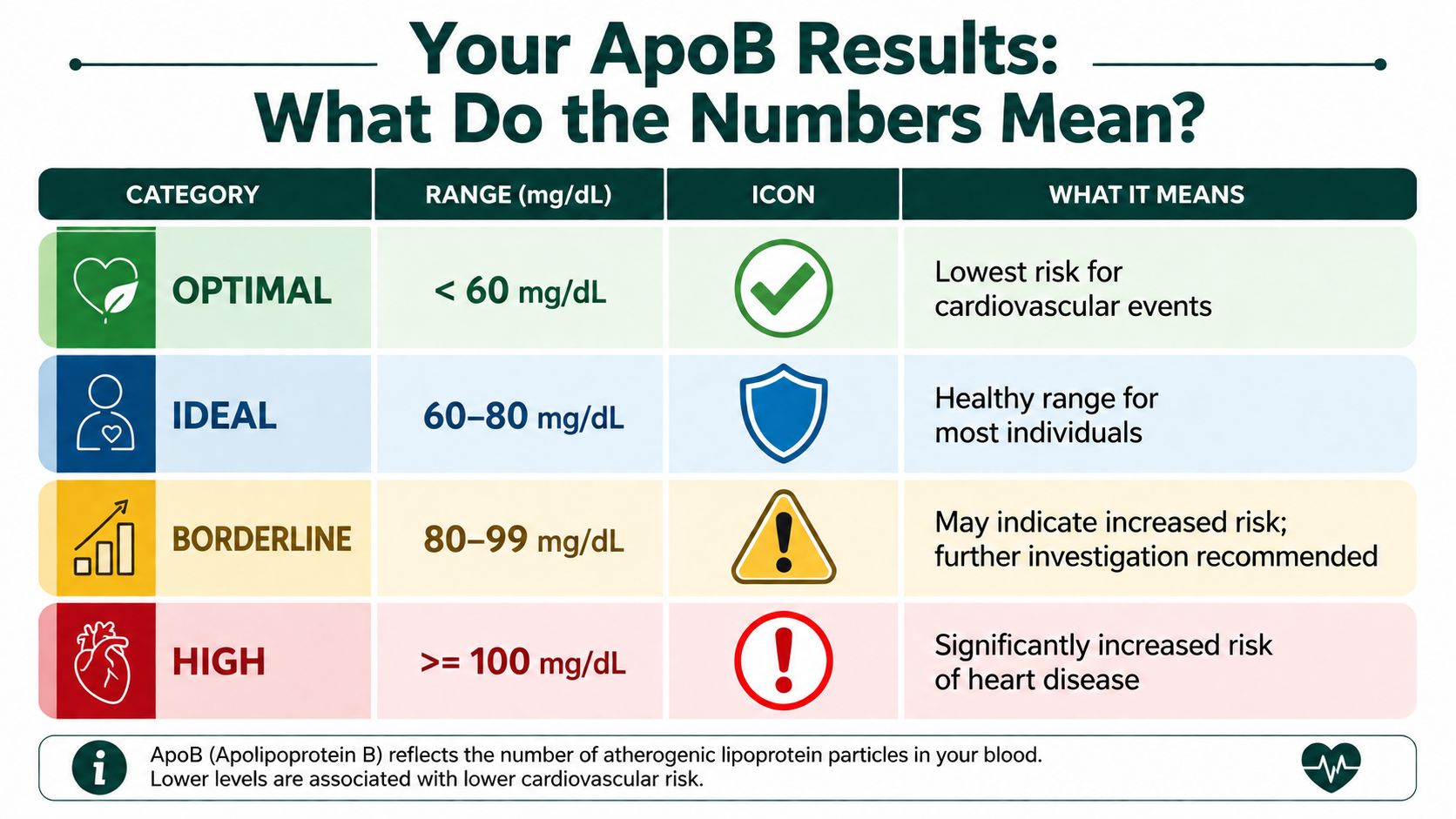
Here is the practical way to read it:
Lower range: Usually reassuring, particularly if triglycerides, glucose control, blood pressure, and family history also look favorable.
Middle range: Often where the standard lipid panel creates false reassurance. This is the group where normal LDL-C can hide a higher-than-expected number of atherogenic particles.
Higher range: Calls for action, not hand-waving. At that point, the conversation usually shifts toward tightening lifestyle inputs, reviewing secondary causes, and considering medication when overall risk supports it.
The middle range deserves the most attention.
ApoB is a particle count. LDL-C is the amount of cholesterol riding inside those particles. If each particle is carrying less cholesterol than usual, LDL-C can look fine while ApoB stays high. That pattern shows up often in people with visceral fat, fatty liver, high triglycerides, prediabetes, or type 2 diabetes.
How to think about the gray zone
A borderline ApoB result does not mean the same thing in every person. In a lean, insulin-sensitive person with low triglycerides and no family history, it may be less concerning. In someone with metabolic syndrome, the exact same result can signal a larger pool of artery-penetrating particles than the basic lipid panel suggests.
That is why I do not read ApoB in isolation. I read it with triglycerides, HDL-C, waist size, glucose markers, blood pressure, and family history. If the case still looks unclear, an NMR LipoProfile for lipoprotein particle analysis can add useful detail.
A few practical points help:
Fasting is usually not required: ApoB is stable enough to be measured accurately without a fasting sample.
Lab methods are reliable: Modern ApoB assays are standardized well enough for tracking over time.
Context changes the meaning: A result that looks only mildly abnormal on paper can matter much more when metabolic health is drifting in the wrong direction.
ApoB works like a headcount of the particles that can enter the artery wall. More particles usually means more opportunities for plaque to form over time.
That is the frame to use. Read the number as cumulative exposure, then decide whether your current plan is enough.
Who Needs an ApoB Test Most
Not everyone gets the same value from ApoB testing. The people who benefit most are usually the ones most likely to be reassured by a normal-looking LDL-C when they shouldn't be.
The normal LDL trap
ApoB is a superior predictor of heart disease risk primarily when metabolic health is impaired. In people with insulin resistance, diabetes, or high triglycerides, a normal LDL cholesterol result can mask dangerously high particle counts, a scenario in which ApoB testing is specifically recommended by the American Heart Association, as discussed in this review on ApoB and metabolic risk.
That's the key nuance most articles miss. ApoB isn't merely “better for everyone in every scenario” in the same way. Its biggest value shows up when particle number and cholesterol mass stop moving together.
People I'd put near the front of the line for an ApoB cholesterol test include:
Those with insulin resistance or diabetes: These states often produce many small, cholesterol-depleted particles.
People with high triglycerides or metabolic syndrome: This is the classic setup for discordance between LDL-C and particle burden.
Anyone with a family history of heart disease: Family risk is a good reason to look beyond the standard panel.
People with low or normal LDL-C who still suspect residual risk: Especially if waist circumference, fatty liver, or glucose control suggest metabolic dysfunction.
Why your doctor may not have ordered it
This part frustrates a lot of informed patients. If ApoB is so useful, why isn't it routine?
The short answer is inertia. Standard cholesterol testing has decades of habit behind it. ApoB also faces real-world barriers, including uneven familiarity, insurance friction, and low testing prevalence despite guideline support.
A test can be clinically useful and still remain underused. Medicine often changes slower than evidence-aware patients expect.
That doesn't mean your physician is ignoring risk. It means you may need to ask a more specific question: “Could ApoB help clarify my risk given my metabolic profile?”
How to Lower Your ApoB and Take Action
A high ApoB result isn't a verdict. It's a target.
What tends to work first
ApoB levels can be lowered using the same broad strategy used for atherogenic cholesterol management: dietary modification, increased physical activity, and medications such as statins, ezetimibe, and PCSK9 inhibitors, as summarized in Learn Your Lipids' ApoB overview.
Start with the levers that improve the overall metabolic environment:
Food quality: Limiting saturated fats is a common starting move. For many people, replacing heavily processed meals with simpler whole-food patterns is more sustainable than chasing a perfect named diet.
Activity: Regular movement helps, especially when combined with resistance training and consistent body-weight management.
Pattern, not hacks: The best plan is the one you'll repeat long enough to change the lab.
If you're adjusting diet, small upgrades can be easier to maintain than dramatic overhauls. For example, foods associated with better overall eating patterns can make adherence simpler. This overview of the health benefits of miso soup is a useful example of how one small meal choice can fit into a more cardiometabolic-friendly routine.
When medication becomes part of the plan
Lifestyle matters, but sometimes it won't be enough on its own.
Medication usually enters the conversation when ApoB remains high despite serious effort, or when overall risk is already high. The practical options often mirror LDL-lowering treatment:
Statins are usually the first-line prescription tool.
Ezetimibe is often added when more lowering is needed.
PCSK9 inhibitors can be considered when risk is higher or earlier options don't get the number where it needs to go.
Work with a physician on this. ApoB is actionable, but the right treatment intensity depends on the whole picture, not one biomarker.
How to Order Your ApoB Test Affordably
The barriers aren't scientific. They're logistical. Where do you get an ApoB cholesterol test, do you need to fast, and what will it cost?

Two practical paths
One route is to order a dedicated Apolipoprotein B test directly through a consumer-access pathway and complete a standard blood draw through a partner lab network.
Another route is blood donation-linked testing. Some people choose donation-based access because they want wellness data and like the public good built into the process. Others prefer a straightforward à la carte order without donating. Both approaches can make sense.
If you're comparing options, cost does matter. Harvard Health notes that ApoB testing is widely accessible and costs around $60 from major laboratory providers in its consumer overview of ApoB test pricing and access.
What the testing process looks like
The sample is a blood draw. Fasting isn't required for accurate ApoB measurement, which makes scheduling easier than many people expect. Turnaround is generally fairly quick through major lab workflows.
Some people also explore adjunct products while working on lipids, though those don't replace testing or physician-guided care. If you're reviewing over-the-counter options in that context, you can shop Reducol Md at Healtsy as one example of a product people may compare while building a broader plan.
A short clinical discussion on who benefits most from ApoB can help you decide whether it belongs in your next round of labs:
FAQs About the ApoB Cholesterol Test
FAQs: ApoB cholesterol test (2026)
Do I need to fast for an ApoB test?
No. A fasting specimen isn't required for accurate ApoB measurement, which makes the test easier to fit into routine lab work.
How much does an ApoB test cost without insurance?
It varies, but consumer pricing can be modest. Harvard Health reports average costs around $60 from major laboratory providers.
Why didn't my doctor order ApoB?
Because uptake is still low. Guideline support exists, but real-world testing prevalence remains low, which helps explain why many patients still aren't offered it routinely.
Is ApoB better than LDL-C?
Often yes for risk clarification. ApoB directly reflects atherogenic particle number, which can reveal risk that LDL-C misses, especially with metabolic dysfunction.
How often should I test ApoB?
It depends on your goal. Retest timing is usually most useful after meaningful lifestyle changes or medication adjustments, using your physician's guidance.
ApoB gives you something a basic cholesterol panel often can't: a clearer read on particle-driven cardiovascular risk, especially when standard numbers look better than they should. If you want affordable access to clinical-grade blood testing through partner labs, or free lab panels tied to blood donation, Goodlabs is one option to review.
This article is for informational and educational purposes only and is not medical advice. Blood test results are not a medical diagnosis. Consult a licensed physician before acting on any lab result or changing medication, supplements, or treatment.

Jake Kaiser
jakesjourney.co