
General Wellness and Longevity
Autoimmune Panel Blood Test: Markers & Results 2026

Jake Kaiser
jakesjourney.co

You've had the basic workup. CBC looked fine. Metabolic panel didn't explain much. Maybe thyroid was normal too. But the fatigue keeps hanging around, your joints ache off and on, your eyes or mouth feel oddly dry, or you get that hard-to-describe mix of brain fog and “something's off.”
That's the point where many people start searching for an autoimmune panel blood test.
The useful way to think about it isn't as one magic blood draw that tells you yes or no. It's a diagnostic sequence. Clinicians use it to ask a more focused question: does your pattern of blood markers fit with immune system activity that deserves a closer look?
The Search for Answers to Invisible Symptoms
Autoimmune problems rarely announce themselves cleanly. They often begin as a pile of small signals that don't seem connected. Morning stiffness. A rash that comes and goes. Hands that swell just enough to notice. A level of exhaustion that sleep doesn't fix.
That's why people often feel dismissed before they feel understood. Standard screening labs are good at spotting many common problems, but they're not designed to map immune misfiring in detail. When symptoms are systemic, you need a different lens.
Goodlabs is a health platform that gives blood donors free clinical-grade lab panels (run at Quest or LabCorp), and offers the same panels at low cost to anyone who doesn't want to donate.
A better autoimmune workup starts with logic, not panic. Instead of asking for “every test,” it helps to understand which markers create a useful trail and which ones only create noise. That same pattern-focused mindset shows up in other conversations about chronic inflammation and gut-immune interactions. If you want a patient-friendly perspective on that overlap, Yuve's perspective on leaky gut is a useful companion read.
For a broader foundation on why vague symptoms can reflect systemic immune activity, Goodlabs also has a helpful explainer on chronic inflammation.
Practical rule: If your symptoms are real but routine labs are unrevealing, the next step isn't random testing. It's more structured testing.
What Is an Autoimmune Panel Really Testing
An autoimmune panel blood test sounds singular. It isn't. In practice, it's a cluster of tests that helps a clinician recognize a pattern across blood cells, organ function, inflammatory activity, and autoantibodies.
A panel is a pattern, not a verdict
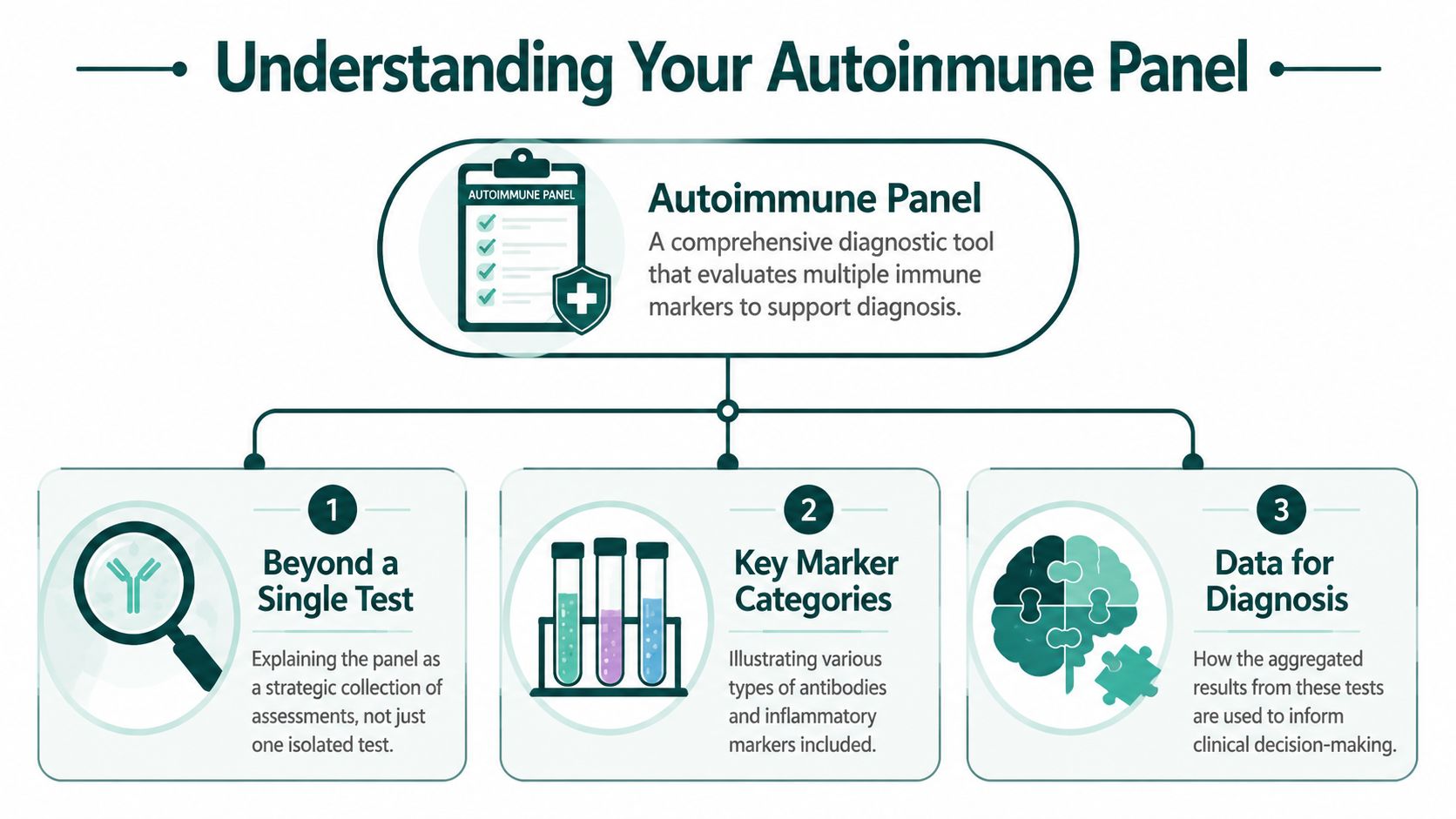
Expert guidance is very clear that “no one laboratory test establishes” an autoimmune diagnosis, and evaluation typically combines a CBC with differential, full metabolic panel, inflammatory markers, autoantibodies, flow cytometry, cytokine analysis, and sometimes HLA typing, as outlined in this clinical review of autoimmune laboratory evaluation.
An analogy is investigating a house with smoke damage. One clue tells you very little. A smoke alarm going off matters. Soot on the walls matters. Heat damage matters. The pattern tells you whether there was a kitchen flare-up or a whole-house fire.
Autoimmune workups use the same logic.
Why the broad workup matters
A clinician usually wants to know several things at once:
Whether blood cells look affected. A CBC may show cytopenias or other shifts that fit immune-mediated disease.
Whether organs look stressed. A CMP can reveal liver, kidney, or electrolyte changes that make the antibody findings more meaningful.
Whether inflammation is active. General inflammatory markers can support the broader picture, even though they aren't disease-specific.
Whether disease-linked antibodies are present. These are the most recognizable part of the panel, but they work best when interpreted in context.
That's why “positive” and “negative” aren't the most useful words by themselves. What matters is whether the results line up with symptoms, exam findings, and the rest of the bloodwork.
The First Clues Screening Tests Like ANA and RF
The first tier of an autoimmune workup is built to cast a wide net. You're not trying to prove a specific disease yet. You're trying to decide whether it makes sense to dig deeper.
ANA is the front door
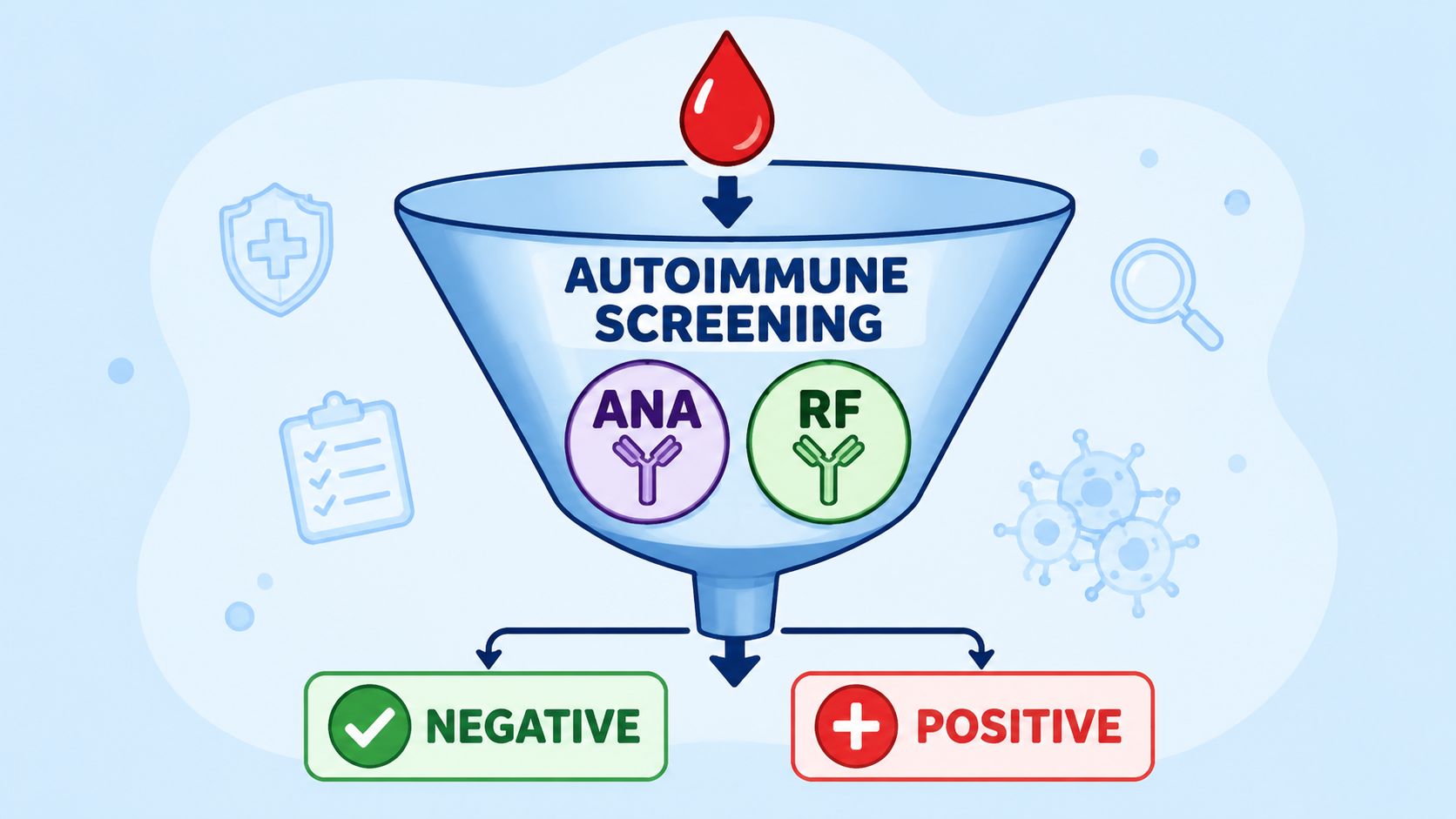
The ANA test is the classic entry point. According to Johns Hopkins Lupus Center's lupus blood test overview, ANA is positive in about 98% of people with systemic lupus erythematosus, which is why it remains the key screening step for lupus. That makes it highly sensitive.
Sensitivity is useful, but it's not the same as specificity.
ANA can also be positive in healthy people, so a positive result doesn't mean lupus, or even autoimmune disease in general. It means the screen picked up antibodies against nuclear material and the finding now has to be interpreted with judgment.
A good screen acts like a smoke detector. It should go off when there's a real problem, even if that means it also goes off for burnt toast.
For people looking at a direct-access option, Goodlabs offers an ANA Screen IFA with reflex to titer and pattern, which matches how clinicians often want this test staged.
What RF and inflammation markers add
Rheumatoid factor, or RF, often enters the picture when symptoms point toward inflammatory joint disease. It's not exclusive to rheumatoid arthritis, and on its own it doesn't settle the question. Still, it can be a useful clue when paired with joint symptoms and follow-up antibodies.
Inflammation markers such as ESR and CRP serve a different role. They don't tell you which autoimmune condition is present. They tell you whether the immune system appears to be stirring up a broader inflammatory response.
That distinction matters:
ANA asks, “Is there enough signal here to suspect autoimmune antibody activity?”
RF asks, “Is there a clue pointing toward rheumatoid-pattern disease?”
ESR and CRP ask, “Does the body look inflamed right now?”
Later in the workup, the broad screen gives way to narrower testing. This short overview is a useful primer before that next layer.
Digging Deeper Confirmatory ENA and Anti-CCP Tests
A positive screening result creates a fork in the road. One path is overreaction. The better path is refinement.
Why ENA comes after ANA
When ANA is positive, clinicians often move to an ENA panel. That follow-up step narrows the field. Lab guidance notes that ENA panels are typically a 4- to 6-test blood panel containing markers such as SSA/SSB, RNP, Sm, Scl-70, and Jo-1, as described in this autoimmune profile overview from Labcorp.
This is the tiered logic that makes autoimmune testing useful. First, use a broad screen. Then test the antibodies that are more disease-linked.
A broad test tells you where to look. A specific antibody tells you what deserves attention.
What the individual antibodies actually tell you
Some of the most practical ENA-era markers are the ones that add specificity to an otherwise broad picture.
Anti-dsDNA matters because it's more tightly linked to lupus than ANA alone.
Anti-Sm is another lupus-associated marker that helps sharpen the signal.
SSA and SSB become especially relevant when symptoms include dry eyes, dry mouth, or other connective-tissue features.
The clinical value of SSA and SSB is especially strong in Sjögren syndrome. Lab guidance reports these markers are present in more than 80% of Sjögren syndrome patients in the right context.
For inflammatory arthritis, anti-CCP often carries more weight than RF when the question is rheumatoid-pattern disease. If that's the branch of the workup you're following, Goodlabs offers a direct-access cyclic citrullinated peptide CCP antibody IgG test.
A practical way to read this tier is simple. ANA opens the file. ENA and anti-CCP help label the folder.
How to Interpret Your Results Patterns and Pitfalls
Most anxiety starts when someone sees one abnormal marker and assumes the blood test has already delivered a diagnosis. That's not how autoimmune interpretation works.
The biggest mistake people make
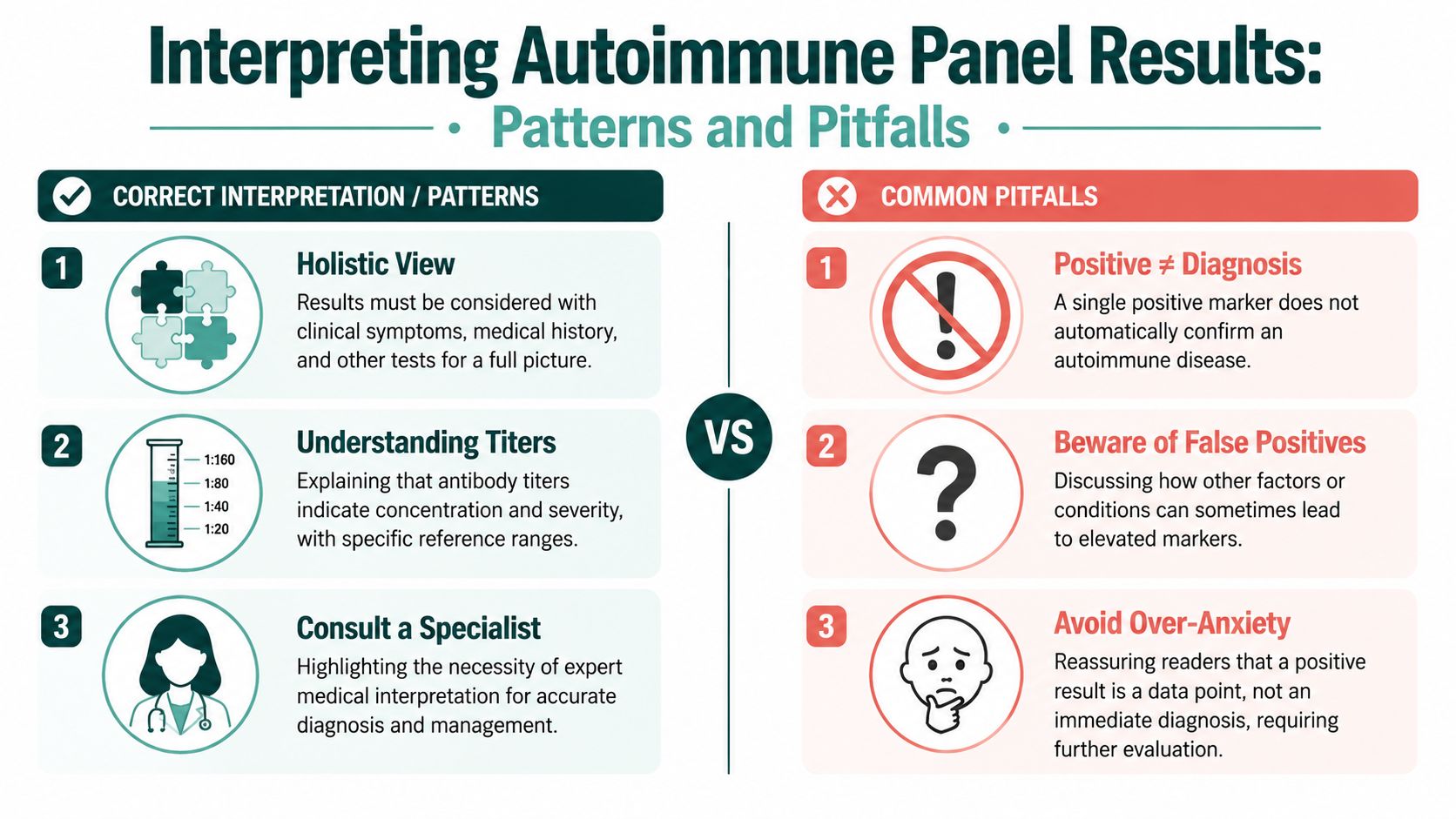
The common error is reading a single antibody result in isolation.
An isolated positive marker can be nonspecific. A clinically meaningful pattern usually includes several layers at once: symptoms that fit, exam findings that fit, broad bloodwork that supports the concern, and antibodies with enough specificity to justify a focused differential.
That's why antibody titers matter too. Titer tells you about concentration through serial dilution, not just presence or absence. It's one more clue about signal strength, but still not a stand-alone verdict.
Positive doesn't mean proven. Negative doesn't always mean nothing. Context does the heavy lifting.
Why prevalence changes how you read a result
Modern autoimmune panels are built around tiered antibody detection, and that design helps interpretation. The Australasian position paper notes the use of methods such as indirect immunofluorescence for ANA and immunoblot or line assays for ENA antibodies. It also summarizes Quest guidance that Tier 2 antibodies are present in less than 2% of normal blood donors, which helps distinguish low-background findings from more clinically meaningful ones in a review of autoimmune laboratory testing.
That prevalence point is the hidden logic behind many panels. Some antibodies are common enough in low levels that they can mislead. Others are uncommon enough in healthy people that they carry more interpretive weight.
If you want another patient-centered way to think about this, LifeWorks Integrative Health has a good piece on how labs can learn about your body's story. The phrase is useful because that's exactly what these panels do. They tell a story in aggregate.
For a broader framework on why “normal” and “optimal” aren't the same thing, Goodlabs has a helpful read on optimal vs normal blood test ranges.
How to Get Tested Process Cost and Access
The practical question is usually simpler than the immunology. How do you get an autoimmune panel blood test without turning it into a months-long insurance project?
What the process usually looks like
There are two common routes.
The traditional route runs through a clinician visit, symptom review, ordered labs, insurance processing, and follow-up interpretation. That route makes sense when symptoms are significant, fast-moving, or clearly tied to a broader clinical picture. It also tends to be the better path when you need exam findings and specialist judgment immediately.
The other route is direct-access testing. That's often useful when you're trying to gather baseline data, follow up on chronic low-grade concerns, or get a clearer starting point before a physician visit.
In most cases, the process is straightforward:
Choose the right starting test. For diffuse symptoms, that often means a screening-focused autoimmune marker rather than an overly broad bundle.
Complete the blood draw at a partner lab or testing location.
Review the pattern, not just the flagged lines.
Take the results to your physician if anything looks clinically relevant or if symptoms persist despite nondiagnostic results.
A few practical trade-offs matter:
Traditional care gives context first. A physician can decide whether autoimmune testing is even the right branch.
Direct access gives transparency first. You see what you're ordering and can often move faster.
Neither replaces interpretation. Bloodwork is data. Diagnosis still requires clinical judgment.
Comparing Autoimmune Panel Access
Factor | Traditional Path (Doctor & Insurance) | Goodlabs Platform |
|---|---|---|
Starting point | Usually begins with an office visit and symptom review | Lets people browse and order tests directly online |
Pricing | Often depends on insurance rules and plan design | Transparent self-pay access, with some panels available free through donation programs |
Speed to order | May involve scheduling delays | Typically faster to initiate |
Clinical context | Built in from the start | Best used alongside your physician's guidance |
Best for | Active symptoms needing direct medical evaluation | People who want easier access to clinical-grade lab data |
If you want the direct-access route, you can book blood tests through Goodlabs. The key is to use access wisely. Order the test that answers the next question, not the one with the longest marker list.
From Confusion to Clarity Your Next Steps
The primary value of an autoimmune panel blood test isn't that it names a condition on the spot. It usually doesn't.
Its value is that it turns vague symptoms into a more structured conversation. Broad screening markers show whether there's enough signal to keep going. Follow-up antibodies narrow the possibilities. The rest of the bloodwork tells you whether the immune signal matches what's happening elsewhere in the body.
That's the insight. Not certainty overnight, but better questions.
If you've been stuck in the loop of “everything looks normal” while your body says otherwise, understanding the logic of the workup helps. You stop chasing random labs and start looking for a coherent pattern your physician can effectively use.
FAQs Autoimmune Panel Blood Test (2026)
What does an autoimmune panel blood test check for?
It checks for patterns that may suggest immune system activity, often combining general bloodwork with autoantibodies rather than relying on one stand-alone result.
Is a positive ANA test proof of autoimmune disease?
No. ANA is a screening test. It can be positive in healthy people, so clinicians usually interpret it alongside symptoms and follow-up antibody testing.
What happens after a positive ANA result?
The next step is often an ENA panel or other targeted antibody testing to narrow the differential and see whether the broader screen points to a specific pattern.
Can an autoimmune panel diagnose lupus or Sjögren syndrome by itself?
No. These tests may help identify markers associated with those conditions, but diagnosis depends on clinical history, symptoms, exam findings, and follow-up evaluation.
Is direct-access autoimmune testing a replacement for a doctor visit?
No. It's useful for gathering data, but results still need clinical interpretation, especially if symptoms are persistent, changing, or severe.
Blood test results are informational and not a medical diagnosis. Talk to your physician about what your results mean for you.
If you want a simpler way to access clinical-grade blood work, Goodlabs lets you order panels online through CLIA-certified partner labs, with some testing available free through blood donation programs and low-cost self-pay options for everyone else.
Jake Kaiser
jakesjourney.co