

If your fasting glucose came back a little high, do you have a problem, or did you just catch your metabolism on a noisy morning?
That question is the gap in most advice about a blood sugar fasting test. People are usually handed a number, a reference range, and maybe a vague comment to “watch it.” But a fasting glucose result isn't a verdict. It's a clue. A useful one, but still just one clue.
The practical mistake is treating a single fasting value like a final grade. A fasting test captures your blood sugar at one moment, under one set of conditions, on one morning. For metabolic health, that's more like a still photo than a full documentary. The number matters. The context matters just as much.
The better way to use a fasting blood sugar test is to read it as part of a pattern. If it's clearly normal, that's helpful. If it's clearly high, that deserves follow-up. If it's borderline, which is where many people get stuck, the key skill is knowing what to do next instead of overreacting or shrugging it off.
Your Fasting Blood Sugar Is Just One Number
A fasting glucose result gets too much emotional power because it looks precise. You see a number on a lab report and it feels objective, final, and personal all at once. But precision on paper doesn't mean completeness in real life.
A blood sugar fasting test is valuable because it checks your glucose in a standardized state, after you've gone without food long enough for recent meals to stop dominating the picture. That makes it one of the foundational screening tools used in routine care. It also means the test is intentionally narrow. It tells you what was happening in that fasted window, not how your body handled breakfast yesterday, not what your glucose tends to do after dinner, and not your longer-term average.
Checking your home's electricity use at dawn before everyone starts cooking, showering, and running appliances offers a useful comparison. That baseline tells you something important about the system. It doesn't tell you everything about peak demand, resilience, or day-to-day stability.
Practical rule: Treat one fasting glucose result as a signal to interpret, not a label to accept.
People often get falsely reassured or needlessly alarmed. A low-normal reading doesn't automatically mean your metabolic health is optimal. A mildly high reading doesn't automatically mean you've crossed into a permanent problem. The test works best when you pair it with context, repeat testing when needed, and a willingness to look at trends instead of clinging to one morning's number.
What a Fasting Blood Sugar Test Actually Measures
A fasting blood sugar test measures your glucose under low-input conditions, after an overnight fast. On a lab report, this is usually listed as fasting plasma glucose.
What matters is the physiology behind the number. By morning, the effect of your last meal has mostly faded, so the test gives a cleaner read on how your body is managing glucose without fresh calories entering the system. That makes it a baseline marker of metabolic control, not a full performance review.
The body's overnight baseline
During a fasted state, your body shifts into maintenance mode. The liver releases stored glucose to keep your brain and other tissues supplied. The pancreas adjusts insulin output. Stress hormones such as cortisol and glucagon also influence the result. Your fasting value reflects the balance among those systems at that moment.
A useful comparison is a car idling at a stoplight. You are not measuring how it performs going uphill or merging onto a highway. You are checking whether the engine is running smoothly with minimal outside demand. That is why fasting glucose can reveal early strain in blood sugar regulation before someone notices clear symptoms.
This also explains the gray zone that confuses people. A fasting result can be mildly high even when day-to-day energy feels fine. That does not prove diabetes, but it can signal that the liver is releasing more glucose than ideal overnight, or that insulin is not keeping up as efficiently as it should.
Why fasting matters
The fast is what makes the result interpretable. If you eat, drink calories, or even change your routine in ways that affect glucose, the number shifts away from baseline and toward a mixed reading.
For someone tracking metabolic health, that distinction matters. A fasting value is best used as one data point in a pattern. It helps answer a narrow question: how is glucose regulation behaving in a controlled morning window? It does not tell you how you respond to a carb-heavy meal, how stable your glucose stays through the afternoon, or what your average has looked like over the past few months.
If you want to see the standard format as a direct-access option, the fasting glucose test page at Goodlabs shows how this marker is typically offered. The practical takeaway is simple. Respect the setup, interpret the number in context, and avoid giving one morning result more certainty than it has.
How to Prepare for an Accurate Fasting Blood Sugar Test
Could one small choice the morning of your test push the number just enough to send you into the wrong category? It can. Fasting glucose is a narrow measurement, so the setup matters almost as much as the lab itself.
What counts as a real fast
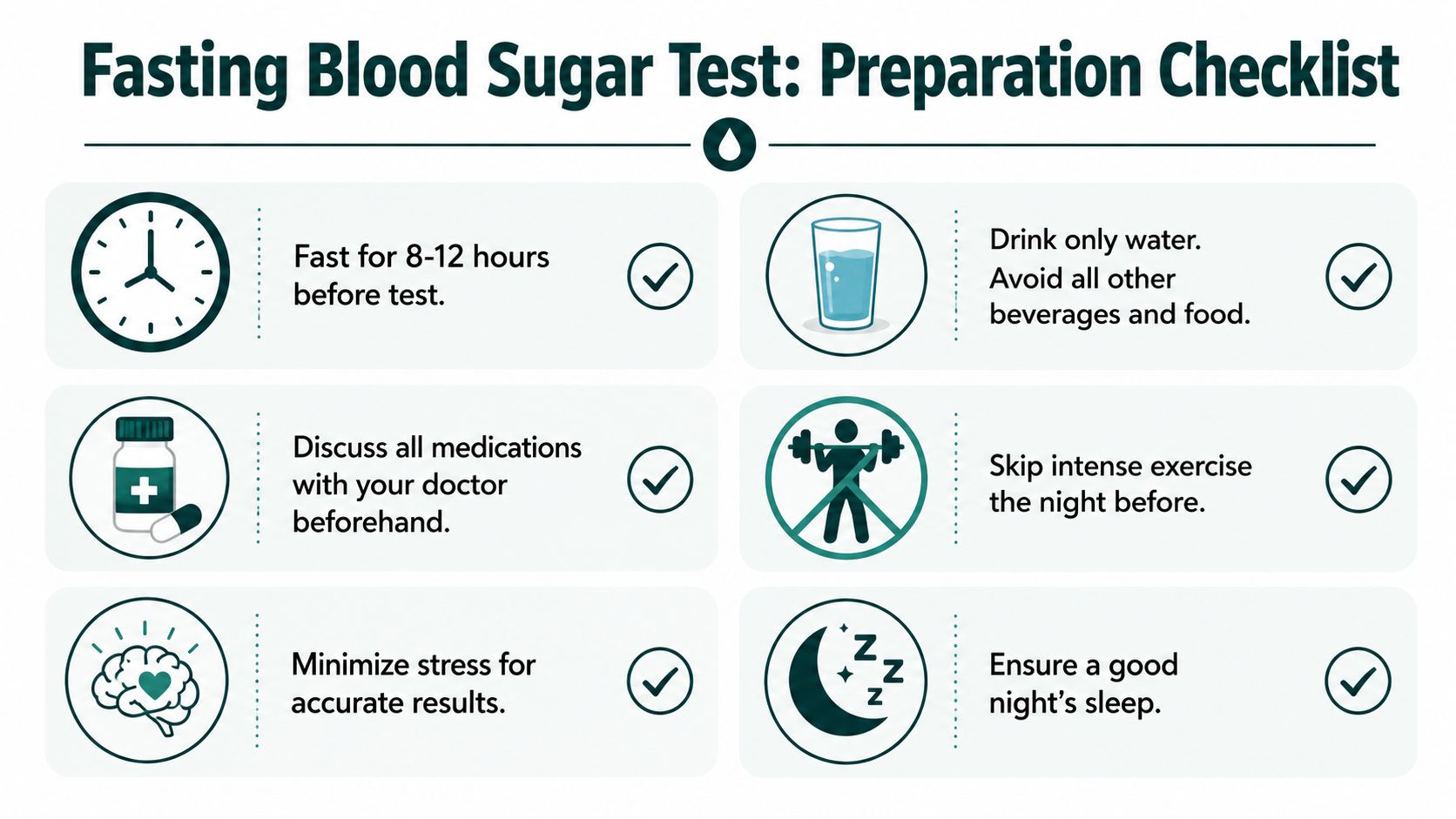
For this test, the goal is a clean baseline. That usually means an overnight fast of at least 8 hours, with water only.
In practice, the rule is simple. No calories after your cutoff the night before, and no morning add-ons that turn a fasting sample into a mixed reading.
Use this checklist:
Stop calories the night before. Food counts, but so do smoothies, alcohol, sports drinks, and late-night snacks.
Drink plain water only. Hydration is fine and often makes the blood draw easier.
Skip “small” exceptions. Cream in coffee, juice, mints, pre-workout powders, and gummy vitamins can all interfere with a true fasting result.
Check medication instructions in advance. Some medicines affect glucose, but do not stop a prescription on your own. Get clear guidance before test day.
Book an early morning appointment if possible. A shorter, consistent overnight fast is easier to repeat than stretching the fast deep into the day.
The boring morning usually gives the best data.
I tell clients to treat test morning like a calibration check. The point is not to game the number lower. The point is to see what your glucose is doing under standard conditions so you can compare this result with future results fairly. If you want to set up a repeat test under similar conditions, the online test booking options at Goodlabs make that easy.
What can distort the reading
Food is the obvious variable, but it is not the only one. A fasting glucose result can shift because your body had a different night or morning than usual.
Common factors include:
Poor sleep. A bad night can change glucose regulation enough to make a borderline result harder to interpret.
Acute stress. A rushed commute, anxiety about the blood draw, or a stressful morning can push glucose higher.
Hard exercise close to the test. Intense training changes fuel use and can temporarily alter the result.
Illness, infection, or recovery. If your body is under strain, the number may reflect that state more than your usual baseline.
This matters most in the gray zone. If your result comes back mildly high, the next question is not just "What is the number?" It is also "Was this a clean test day?" A reading near a cutoff carries more uncertainty than many people realize, which is why consistent preparation makes follow-up testing far more useful.
This is also a good place to use the video below if you want a quick visual refresher on test setup and interpretation.
Decoding Your Results Normal and Diagnostic Ranges
What does one fasting glucose number mean for you today, not just on a lab report?
Start with the clinical category, then add context. Fasting blood sugar is generally classified as normal below 100 mg/dL, prediabetes at 100 to 125 mg/dL, and diabetes at 126 mg/dL or higher after an overnight fast.
Category | Result (mg/dL) | Result (mmol/L) |
|---|---|---|
Normal | Below 100 | Below 5.6 |
Prediabetes | 100–125 | 5.6–6.9 |
Diabetes | 126 or higher | 7 or higher |
Those cutoffs matter because they shape decisions. They help determine whether a result is reassuring, whether it should be repeated, and whether it deserves follow-up with a clinician.
The practical mistake is treating the range boundary like a hard cliff. A result of 99 mg/dL and 101 mg/dL does not represent two radically different metabolic states. It represents two nearby points on the same spectrum, with some built-in test noise and some real biologic variation layered on top.
That gray zone is where interpretation matters most.
A value well below 100 mg/dL usually supports the idea that fasting glucose is under reasonable control, especially if it fits the rest of the picture. A value clearly above 126 mg/dL deserves prompt confirmation and a broader workup. A value in the middle, or right around a cutoff, calls for more restraint and better thinking. Was the test collected under typical conditions? Does it match prior labs? Does the person also have other signs of insulin resistance, such as increased triglycerides, increased waist size, rising blood pressure, or a strong family history?
This is also where "normal" and "optimal" can diverge. A lab may mark a result as normal, but a data-focused reader may still want to understand whether the number is trending in the wrong direction over time. This article on optimal vs normal blood test ranges gives useful context for that distinction.
Key takeaway: Cutoffs are decision tools. They help organize next steps, but they do not capture your full metabolic picture by themselves.
In practice, I treat a single fasting glucose result like one frame from a longer film. It can be very informative, but the next move depends on where that frame sits. If the number is comfortably normal, keep an eye on trend and overall lifestyle. If it is borderline, repeat it under similar conditions and compare it with other markers. If it is clearly high, act on it.
For readers trying to place fasting glucose in a wider risk pattern, Blue Haven RX's insights on metabolic syndrome are a useful companion. High fasting glucose often travels with other metabolic signals, and the cluster matters more than any one isolated number.
Common Causes of an Abnormal Fasting Glucose Result
A high fasting glucose can reflect a real metabolic issue. It can also reflect a temporary disturbance. The hard part is telling those apart without either minimizing the result or catastrophizing it.
When the cause is metabolic
The common long-range explanation is some degree of impaired glucose regulation, often tied to insulin resistance. In plain English, your body isn't handling baseline glucose as efficiently as it should.
That doesn't always announce itself dramatically. Many people feel completely normal while fasting glucose starts drifting up. That's part of why this marker is useful for screening. It may help identify a pattern worth investigating before symptoms push the issue.
If you're trying to connect a fasting glucose result to a wider risk picture, Blue Haven RX's insights on metabolic syndrome are worth reading. It helps frame high glucose levels as one piece of a broader metabolic pattern rather than an isolated lab oddity.
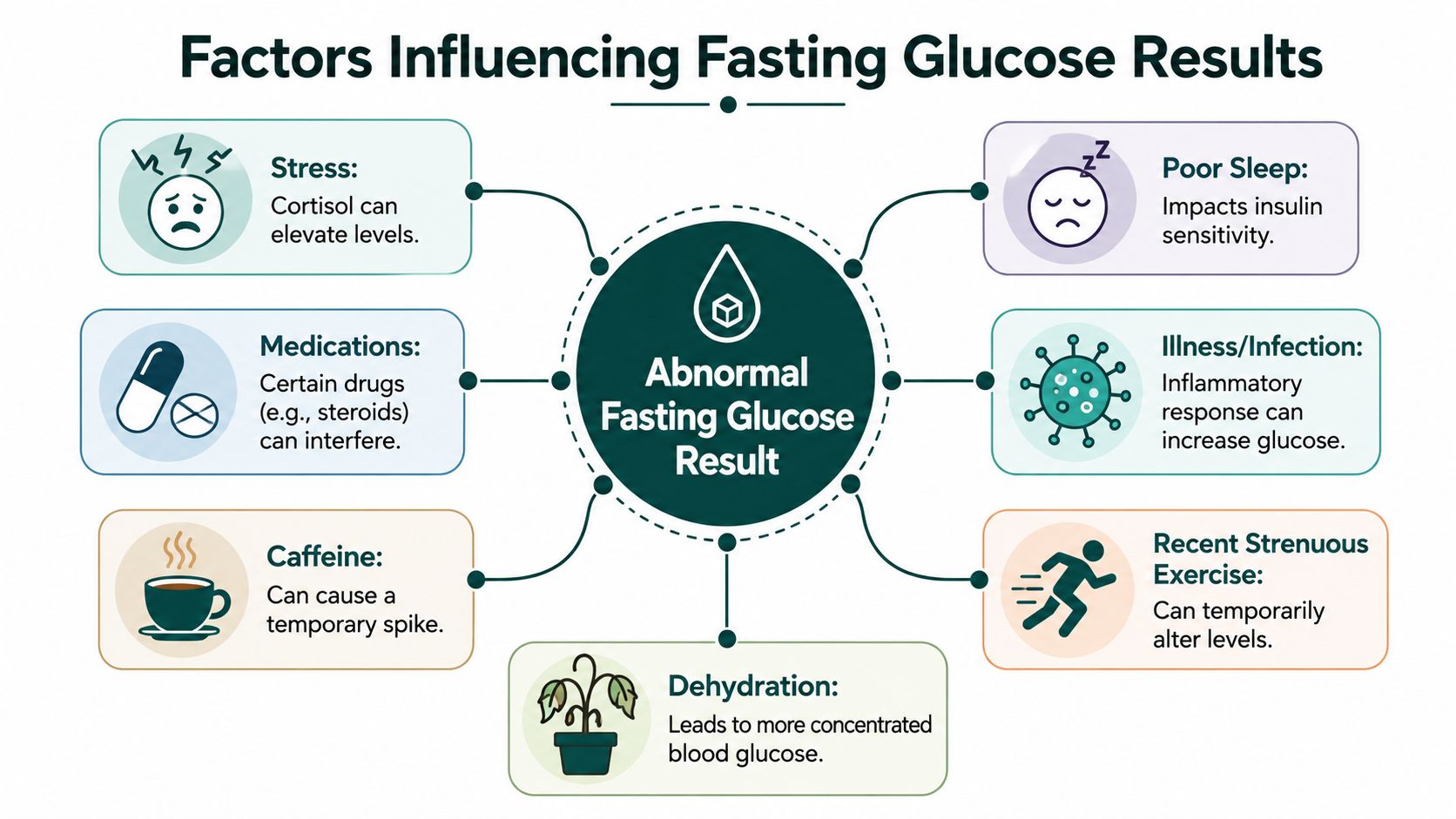
When the cause is situational
Fasting glucose is more sensitive to short-term variation than HbA1c. Factors like overnight fasting quality, acute stress, and recent illness can shift the result enough to move a person across diagnostic cutoffs, which is why diabetes diagnosis requires confirmation with a second test (NIDDK clinical guidance on diabetes and prediabetes).
That sensitivity explains a lot of confusing results. A person can test in the normal range one time and in the prediabetes range another time without their whole metabolism changing overnight.
Situational causes can include:
Stress hormones that raise glucose availability
Poor sleep that leaves fasting physiology less stable
Acute illness that changes how the body manages energy
Medication effects that interfere with glucose regulation
Morning hormone surges, often called the dawn phenomenon
Dehydration or caffeine, which can make a clean interpretation harder
This is why “abnormal” doesn't automatically mean “settled.” It means the result deserves thoughtful follow-up.
Why a Single Test Is Not Enough Glucose vs HbA1c and OGTT
A fasting glucose result answers one narrow question. What was your blood sugar under fasting conditions on that specific morning? That is useful, but it does not tell you how stable your glucose runs across weeks or how well your body handles a carbohydrate challenge.
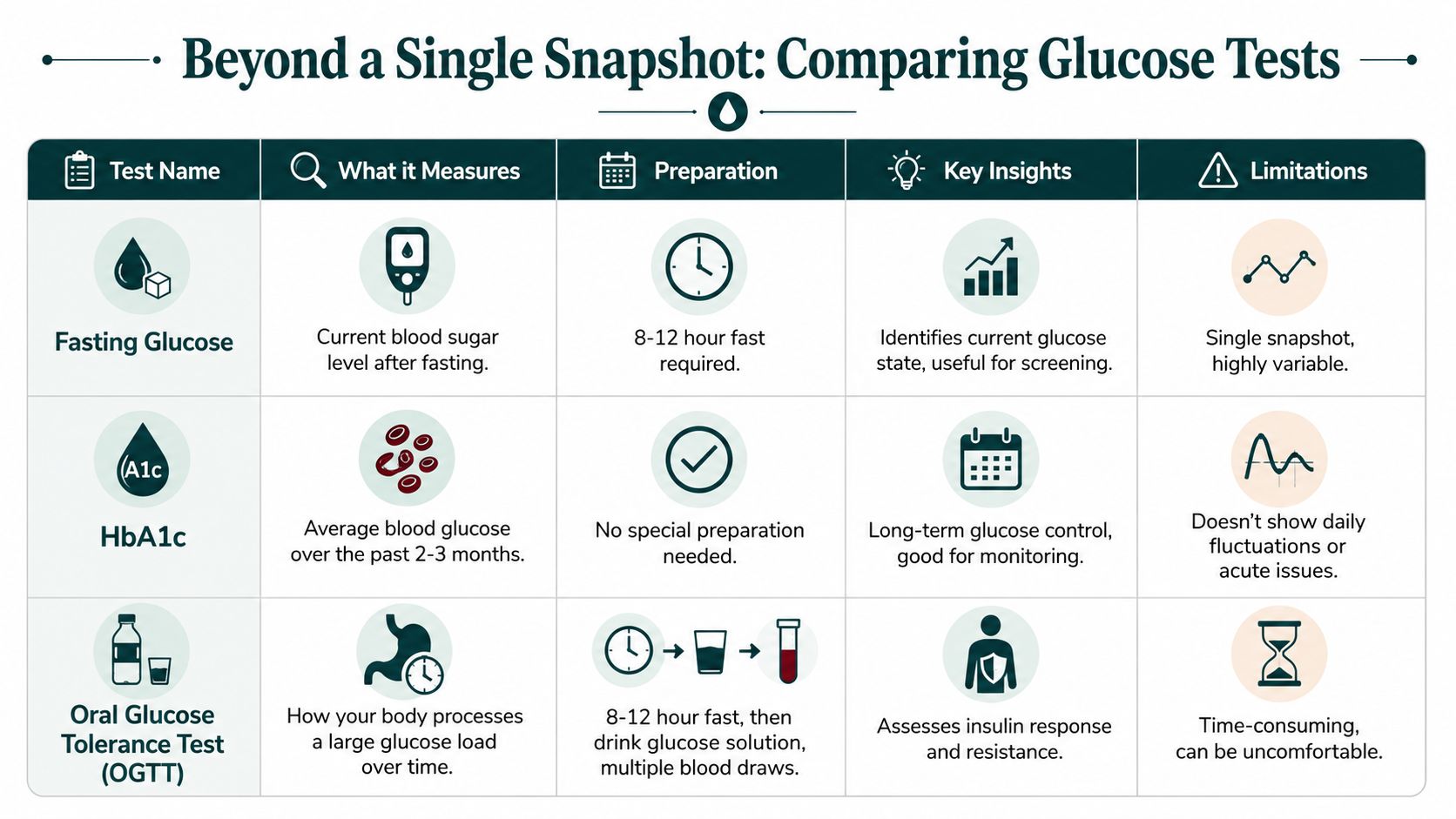
How the three tests differ
In practice, these tests answer different metabolic questions.
Test | What it shows | Best use | Main trade-off |
|---|---|---|---|
Fasting glucose | Your glucose after an overnight fast | Quick baseline screening | Sensitive to short-term variation |
HbA1c | Your longer-term average glucose pattern | Checking whether a borderline fasting result fits a broader trend | Can miss short-term swings and some post-meal problems |
OGTT | How glucose changes after a measured sugar load | Catching impaired glucose handling that a fasting test can miss | Takes more time and planning |
Fasting glucose is the snapshot. HbA1c gives the wider trend. OGTT works like a stress test for glucose control.
That difference matters most in the gray zone. A fasting result can look acceptable while post-meal control is already slipping. The reverse can also happen. I see people focus too hard on a single fasting number when the better question is whether multiple markers point in the same direction.
When each test adds value
Use fasting glucose for a starting point. Use HbA1c when you want context around that starting point. Use OGTT when the situation is still unclear, especially if fasting glucose and symptoms, family history, or other risk markers do not line up cleanly.
For readers who want the dynamic option, the oral glucose and insulin tolerance test at Goodlabs can add clarity when a fasting result raises concern but does not settle the issue.
This is also where behavior data helps. If your labs sit near the borderline range, a structured exercise routine can improve insulin sensitivity and give you another signal to track over time. A practical place to start is how to manage pre-diabetes with home workouts.
The goal is not to collect tests for the sake of it. The goal is to match the test to the question, then compare results across time instead of reacting to one reading in isolation.
Your Next Steps Accessing Tracking and Interpreting Your Results
Individuals don't need more health anxiety. They need a better decision process. That's especially true after a borderline fasting result.
A key challenge is interpreting a 100 to 125 mg/dL result. Medical guidance emphasizes that diagnosis isn't based on one number alone, which is particularly important for people without symptoms who assume a single test settles their risk (NIDDK overview of diabetes tests and diagnosis).

What to do after a borderline result
Start with restraint, not denial.
If your fasting glucose lands in the borderline range, a practical sequence looks like this:
Check the setup Ask whether the fast was clean, the morning was unusually stressful, or you were sick, underslept, or recovering from hard training.
Repeat the test when appropriate One mildly raised result is a reason to clarify the picture, not jump straight to conclusions.
Add a longer-view marker Pairing fasting glucose with HbA1c testing through Goodlabs can help you compare a single-morning value with a broader glucose pattern.
Use lifestyle changes as data-generating interventions Improve sleep regularity, tighten meal quality, increase activity, and then re-check. Don't guess whether the plan worked. Measure it.
If you're looking for low-friction movement ideas, this guide on how to manage pre-diabetes with home workouts is a practical starting point for people who need something realistic, not elaborate.
Why trends beat isolated numbers
Goodlabs offers a natural solution. Goodlabs is a health platform that gives blood donors free clinical-grade lab panels (run at Quest or LabCorp), and offers the same panels at low cost to anyone who doesn't want to donate. That model matters because metabolic testing gets more useful when you can afford to repeat it and compare results over time.
A single fasting glucose number can start the conversation. A sequence of results can change the quality of the conversation.
When people track longitudinally, they stop asking, “Is this one result good or bad?” and start asking better questions:
Is my baseline stable or drifting?
Did my sleep, diet, training, or stress management change the trend?
Does my fasting glucose match my HbA1c, or is there a mismatch worth discussing with my physician?
That shift is the key. You move from reacting to lab flags to building a clearer metabolic picture. And when you do talk with your physician, you aren't showing up with one mysterious number. You're showing up with context.
Blood test results are informational and not a medical diagnosis. Talk to your physician about what your results mean for you.
If you want an easier way to retest fasting glucose, add HbA1c, or track your results over time, Goodlabs makes that process simple. You can get clinical-grade lab panels free with a qualifying blood donation through partner blood centers, or order the same tests directly at low cost without donating.

Jake Kaiser
jakesjourney.co