
General Wellness and Longevity
Get Lab Work Done: Paths to Testing & Results

Jake Kaiser
jakesjourney.co

Most advice about getting lab work done is too passive. It assumes you wait for an annual physical, accept whatever basic panel gets ordered, and glance at a PDF once a year.
That approach misses the core value of testing. Lab medicine sits at the center of modern care. Mayo Clinic Laboratories reports that test results inform 70% of medical decisions and cites 14 billion lab tests conducted annually by laboratory staff, which tells you this isn't fringe optimization but core medicine (Mayo Clinic Laboratories on the impact of laboratory medicine).
The smarter question isn't just how to get lab work done. It's which path gives you the right mix of access, cost control, and usable health data. In practice, options typically include physician-ordered testing, direct-to-consumer ordering, and newer models that connect blood donation with wellness labs.
If you think about labs that way, you stop being a passenger in the system and start building a health data strategy. That's where testing becomes useful, not just administrative.
Why Your Annual Physical Is Just the Starting Point
An annual physical is useful. It just shouldn't be your entire lab strategy.
The standard routine is reactive by design. You go in once a year, answer a few questions, maybe get a basic panel, and move on unless something looks obviously off. That works for broad preventive care, but it doesn't work well if your goal is tighter feedback on metabolism, cardiovascular risk, training recovery, hormones, or long-term trend tracking.
Annual care is broad, not personalized
Primary care has to cover a lot of ground fast. That means the default lab set often prioritizes common screening and clinical necessity, not deep personalization. If you want a sharper picture, you usually need to ask better questions and choose a testing path that fits what you're trying to learn.
Practical rule: Treat your annual physical as a baseline checkpoint, not the only time you look under the hood.
A better frame is this: routine blood work supports prevention, monitoring, and treatment decisions across primary care, specialty care, and hospital settings. That's why getting labs done consistently matters, especially if you're trying to spot patterns before they become bigger problems.
If you want a deeper case for consistency, Goodlabs has a useful overview of the benefits of regular blood testing.
The real decision is pathway selection
There are typically three workable routes:
Physician-ordered labs when you want formal clinical oversight
Direct-access labs when you want speed and control
Donation-linked or low-cost hybrid models when you want affordability plus easier repeat testing
Goodlabs is a health platform that gives blood donors free clinical-grade lab panels (run at Quest or LabCorp), and offers the same panels at low cost to anyone who doesn't want to donate.
That's a different model from both the classic doctor's office route and the standard self-order route. And if you care about getting lab work done without unnecessary friction, those differences matter more than is commonly realized.
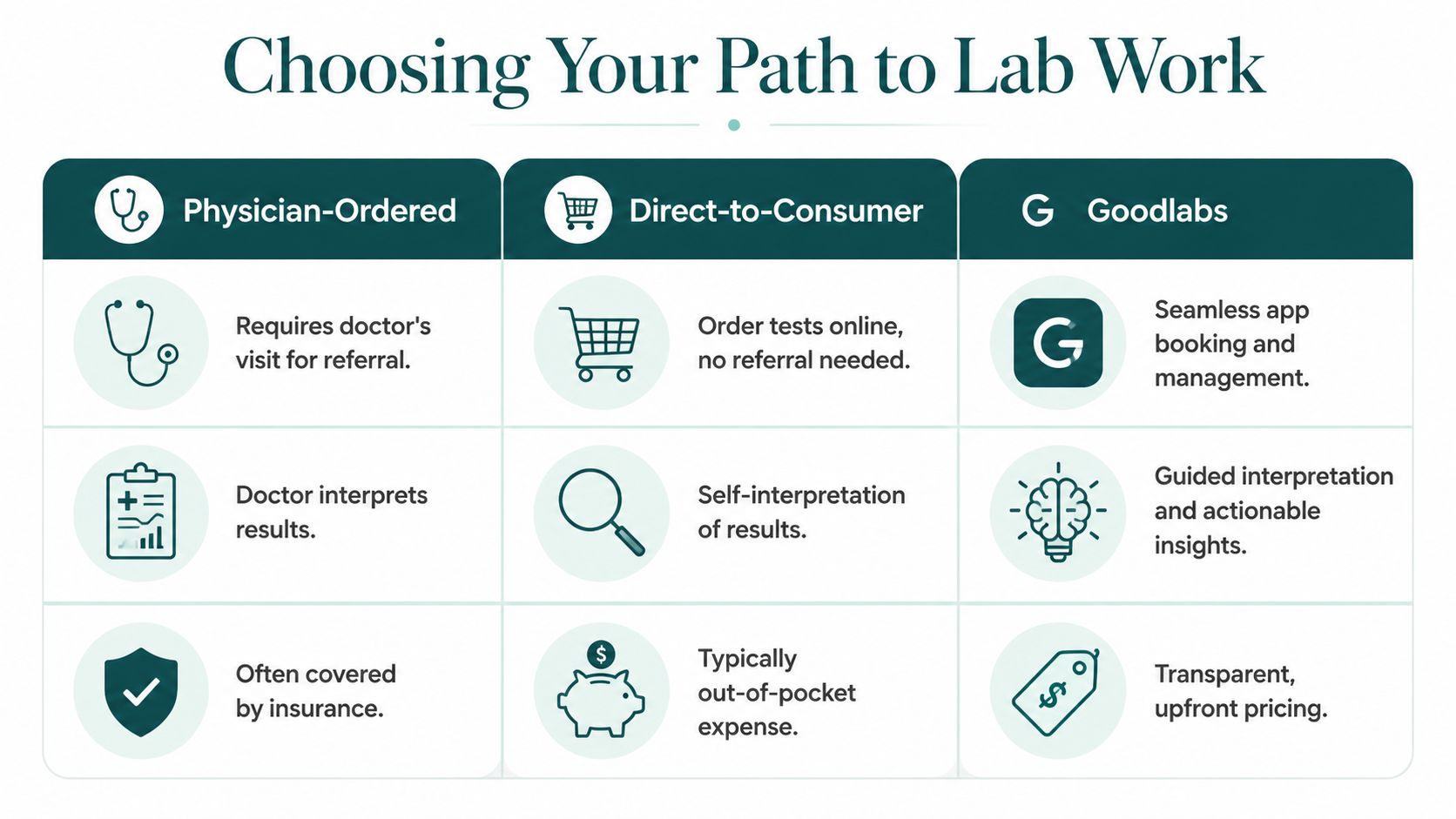
Choosing Your Path Physician vs Direct vs Goodlabs
The biggest mistake I see is people choosing a testing route by habit. They use whatever path they've always used, even when their goals have changed.
The better move is to match the route to the job.
Physician-ordered testing
This path makes sense when symptoms are involved, when you need a clinician to decide what to order, or when interpretation is likely to be complex.
What works
Clinical context: Your physician can connect lab values to symptoms, history, medications, and follow-up care.
Insurance alignment: Some testing may fit more naturally inside routine care or disease management.
Less self-navigation: You don't have to decide everything yourself.
What doesn't
Friction: Scheduling the visit, getting the order, then getting the draw can drag out a simple task.
Limited autonomy: If you want niche or optimization-focused markers, you may need to push for them.
Timing mismatch: You might want data now, but the visit cadence says later.
Direct-to-consumer testing
This route is best when you already know what you want to measure and don't want to wait for permission.
What works
Control: You choose the biomarkers and order on your own schedule.
Speed: No office visit just to obtain a lab slip.
Clearer shopping experience: You can compare panels directly.
What doesn't
Interpretation burden: You're responsible for deciding what matters and what to ignore.
Easy to over-order: More available tests doesn't always mean more useful insight.
Out-of-pocket reality: Convenience often means paying directly.
Convenience isn't just about preference. For many people, it determines whether testing happens at all.
Access matters here. Quest Health notes in-home service is available in some areas, which highlights a broader shift toward more flexible collection pathways and the role convenience can play when transportation or mobility is a barrier (Quest Health testing options and access pathways).
A hybrid route through Goodlabs
Some people want the autonomy of direct ordering without the usual subscription feel or the dead-end experience of getting a result and being left alone with it.
That's where a hybrid option can fit. You can book tests through Goodlabs if you want direct access, or use the donation-linked route if you're already planning to give blood and want lab data attached to something you'd do anyway.
Here's the simplest way to think about the trade-offs:
Path | Best for | Main upside | Main drawback |
|---|---|---|---|
Physician-ordered | Symptoms, clinical follow-up, complex cases | Medical oversight | More scheduling friction |
Direct-to-consumer | Fast self-service testing | Autonomy and speed | More self-interpretation |
Goodlabs | Repeat testing with cost awareness and flexible access | Donation-linked free labs or low-cost ordering | Still requires you to choose intentionally |
If your budget is tight, your transportation is inconsistent, or you're trying to test more regularly, pathway choice can matter as much as the biomarkers themselves.
Selecting the Right Biomarkers Beyond the Basics
Once you've picked the path, the next question is harder. What should you test?
Individuals often either under-order and learn very little, or over-order and create noise. The useful middle ground is to choose biomarkers based on the decision you want the results to support.
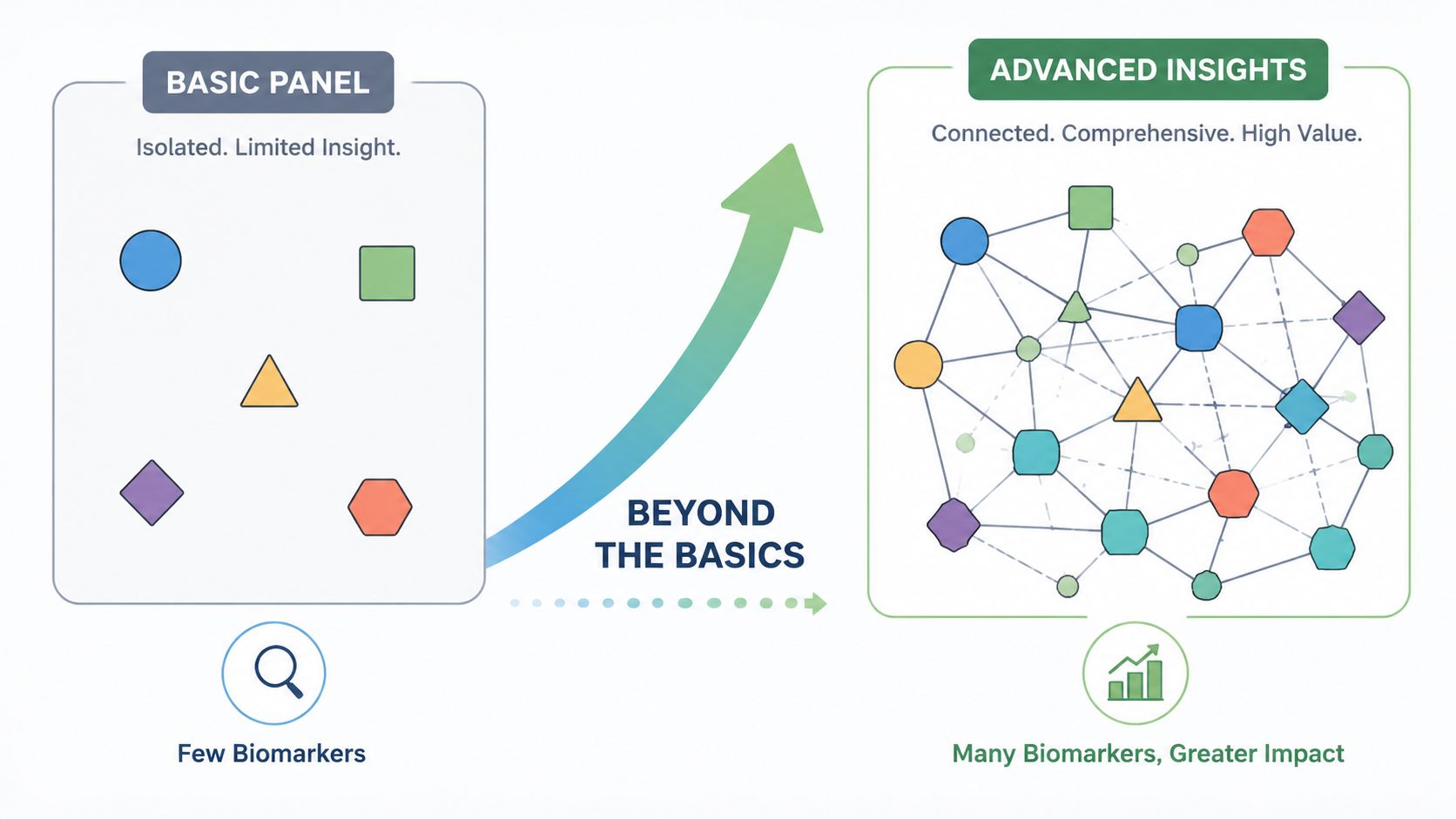
Pick markers by goal, not by panel size
A giant panel sounds complex. Often it just makes interpretation harder.
Use goals like these instead:
Heart health: Go beyond a standard cholesterol snapshot when needed. ApoB measures the number of atherogenic lipoprotein particles, which can provide sharper insight into cardiovascular risk than a basic lipid readout alone. Lp(a) is a genetically influenced lipoprotein linked to inherited cardiovascular risk patterns.
Inflammation and recovery: hs-CRP stands for high-sensitivity C-reactive protein. It may help identify low-grade systemic inflammation associated with cardiovascular and metabolic risk.
Metabolic health: Glucose-related markers, insulin-related markers, and liver-associated markers such as GGT can help you understand how you're responding to diet, training, sleep, and alcohol intake.
Hormone questions: Context matters a lot here. Age, sex, cycle timing, symptoms, and medication use all change what a useful hormone panel looks like.
Where advanced markers earn their keep
The primary value of advanced labs isn't novelty. It's decision quality.
If a marker won't change what you do next, it usually isn't worth chasing. If it may help identify patterns tied to cardiovascular risk, metabolic stress, inflammation, or hormone shifts, it can earn a place in your stack.
For readers trying to sort out age- and symptom-specific hormone testing, this breakdown of menopause tests is a good example of how focused testing beats random panel shopping.
For a broader longevity lens, Goodlabs also has a useful primer on blood tests for longevity.
A smart panel should answer a real question. It shouldn't just satisfy curiosity for a week.
The Logistics From Booking to Blood Draw
This is the part people overestimate. The admin feels bigger than it is.

What to do before you show up
Start with the instructions attached to the test. If fasting is required, follow that instruction exactly. If it isn't, don't add unnecessary restrictions just because social media told you to. Hydrate normally, bring ID, and know whether you're going to a partner lab or a blood center.
If you're using a donation-based route, checking available partner blood centers before you book will save time and reduce last-minute scrambling.
A few practical habits make the process smoother:
Book around your real schedule: Don't choose a perfect time you'll probably miss.
Read prep instructions once the day before: That's when people catch avoidable issues.
Bring your current medication and supplement list: It's useful context if questions come up.
What the blood draw is actually like
Most blood draws are quick and uneventful. MedlinePlus notes that venipuncture usually takes less than five minutes, and the amount collected for many tests is only 5 to 10 milliliters (MedlinePlus blood testing overview).
That small sample can still support a surprising amount of useful information. In practical terms, this is one of the highest signal-to-hassle procedures in preventive health.
If you can tolerate a brief needle stick, you can handle routine lab work.
This walkthrough helps if you want to see the process in motion:
After the draw, the main job is simple. Wait for the results, then read them in context instead of reacting to one flagged line item.
From Raw Data to Real Insights Understanding Your Results
A lab report is not the finish line. It's raw material.
A common tendency is to either skim for red flags and stop there, or to spiral over one out-of-range value. Neither is a good system. Good interpretation means looking at the marker, the pattern, the reason you tested, and what action the result might support.

A better way to read a lab report
Use this sequence:
Start with the purpose. Why did you order this test in the first place?
Review the full cluster. Related markers usually tell a better story than isolated values.
Check for trend direction. A single point matters less than repeated movement over time.
Decide on a next step. That could be watchful tracking, lifestyle changes, or a physician conversation.
If you want a cleaner framework for interpreting ranges, Goodlabs has a helpful explainer on optimal vs normal blood test ranges.
Avoid the more-data trap
One of the under-discussed problems in self-directed testing is overtesting. Laboratory stewardship literature emphasizes appropriate testing, which is the opposite of the consumer instinct to order everything available (laboratory stewardship and appropriate testing).
That matters because extra data can create confusion as easily as clarity. A marker is valuable when it helps you make a better decision, not when it gives you another tab to obsess over.
If you're using pre-tax health funds for eligible wellness and care expenses, this guide to HSA eligible items can help you think more practically about budgeting.
Good labs don't just give you numbers. They give you a repeatable decision loop.
The long game is simple. Test with intent, compare against your own history, and bring the results into a more informed conversation with your physician when needed.
Using Your Health Data for a Longer Healthspan
The mistake is treating lab work like a once-a-year chore. Used well, it becomes a decision tool.
The goal is not to collect more numbers. The goal is to build a record you can use. That means choosing the testing path that fits the job. A physician visit makes sense when symptoms, insurance coverage, or treatment decisions are involved. Direct-to-consumer testing works well when speed, privacy, and control matter more. Goodlabs sits in a practical middle ground for people who want lower-cost access and are comfortable managing more of the process themselves.
What matters over time is not the PDF sitting in your inbox. It is whether you can compare results across months or years, tie those results to changes in sleep, training, diet, or medication, and decide what deserves action.
That is where healthspan enters the picture.
A fasting insulin result is more useful when you can see where it was six months ago. ApoB matters more when you can track whether your nutrition changes or lipid-lowering plan changed the trend. Thyroid markers matter more when you test under similar conditions and stop chasing random one-off swings.
Data ownership is part of the trade-off, too. Going through a doctor can give you clinical context and follow-up care, but you may get a narrower panel and less flexibility over timing. Going direct usually gives you more control over what gets tested and when, but you take on more responsibility for interpretation. Donation-based options can reduce cost substantially, though availability and panel selection may be less predictable.
The smart move is to pick one route, use it consistently, and retest with intent. Consistency beats novelty here.
Blood test results are informational and not a medical diagnosis. Talk to your physician about what your results mean for you.
If you want a simpler way to act on this, Goodlabs offers a practical middle ground: free clinical-grade lab panels with qualifying blood donations, plus low-cost direct access for people who don't want to donate. The model is straightforward, the testing runs through CLIA-certified partner labs, and it gives you a cleaner way to build repeatable health data without turning the process into a subscription hobby.
Jake Kaiser
jakesjourney.co