

Nutrition & Deficiencies
Mastering High Fiber Low Carb: Boost Metabolic Health

Jake Kaiser
jakesjourney.co
Mastering High Fiber Low Carb: Boost Metabolic Health
The most popular advice around low-carb eating is also the reason many people quit. Cut carbs hard, eat more fat, avoid anything that looks remotely plant-heavy, then wonder why digestion gets weird, meals get repetitive, and energy feels less stable than promised.
That approach confuses carb reduction with metabolic improvement. They aren't the same thing. If you strip out refined starches and sugars but also strip out fiber, you often build a diet that looks disciplined on paper and underperforms in real life.
A better target is high fiber low carb eating built from whole foods that keep digestible carbs controlled while pushing fiber high enough to support satiety, gut function, and better metabolic markers. That's the version people can sustain.
The Problem with Typical Low-Carb Diets
Why low-carb often turns into low-fiber
Most low-carb plans fail for a boring reason. They over-focus on what to remove and under-focus on what has to remain.
In the U.S., fiber intake is already low. The CDC says adults should aim for 22 to 34 grams of fiber per day depending on age and sex, while other nutrition sources cited in major consumer coverage report that only about 5% of American adults meet the recommended 25 to 38 grams per day. At the same time, low-carb diets are commonly defined as 20 to 50 grams per day for very low-carb plans, or fewer than 130 grams per day more broadly, which is why combining both goals takes deliberate food selection, not random carb cutting (Healthline summary of fiber targets and low-carb definitions).
That mismatch creates the classic low-carb trap. Someone cuts bread, rice, beans, fruit, and most starches, but doesn't replace them with enough seeds, avocados, leafy vegetables, cruciferous vegetables, or berries. The result is a menu that's technically lower in carbs and practically poor in fiber.
Practical rule: If your low-carb diet is mostly eggs, cheese, meat, shakes, and packaged keto snacks, it's probably low in the one carbohydrate fraction that actually does heavy lifting for metabolic health.
What stops working in the real world
Sustainability falters. People notice less meal volume, fewer plants, and a routine that gets strangely dependent on bars, powders, wraps, and “keto” substitutes. Digestion often becomes the first signal that something is off, but it doesn't stop there.
A low-fiber version of low-carb eating also makes it easier to drift into nutrient gaps, especially when variety drops. That pattern overlaps with the issues covered in this guide to common nutrient deficiencies on restrictive diets.
Three real trade-offs show up fast:
Less satiety from whole plants: Meals can become calorie-dense without being physically satisfying.
Less dietary variety: The diet narrows into a short list of safe foods, which makes adherence harder.
False confidence from “carb avoidance”: You can avoid obvious carbs and still build a diet that doesn't support long-term metabolic health particularly well.
The better question isn't “How low can I get carbs?” It's “How low can I keep digestible carbs while still eating enough fiber to make the diet worth doing?”
That shift changes everything. It moves you away from carb fear and toward food quality.
Rethinking Carbs The Power of Fiber and Net Carbs
Why total carbs can mislead you
Not all carbs behave the same way in the body. That's the missing concept.
Net carbs are calculated as total carbohydrate minus fiber. The reason that matters is simple. Fiber is a carbohydrate, but it isn't digested the same way as starch or sugar. If total carbs are the full tollbooth line, fiber gets waved through without paying the same metabolic toll.
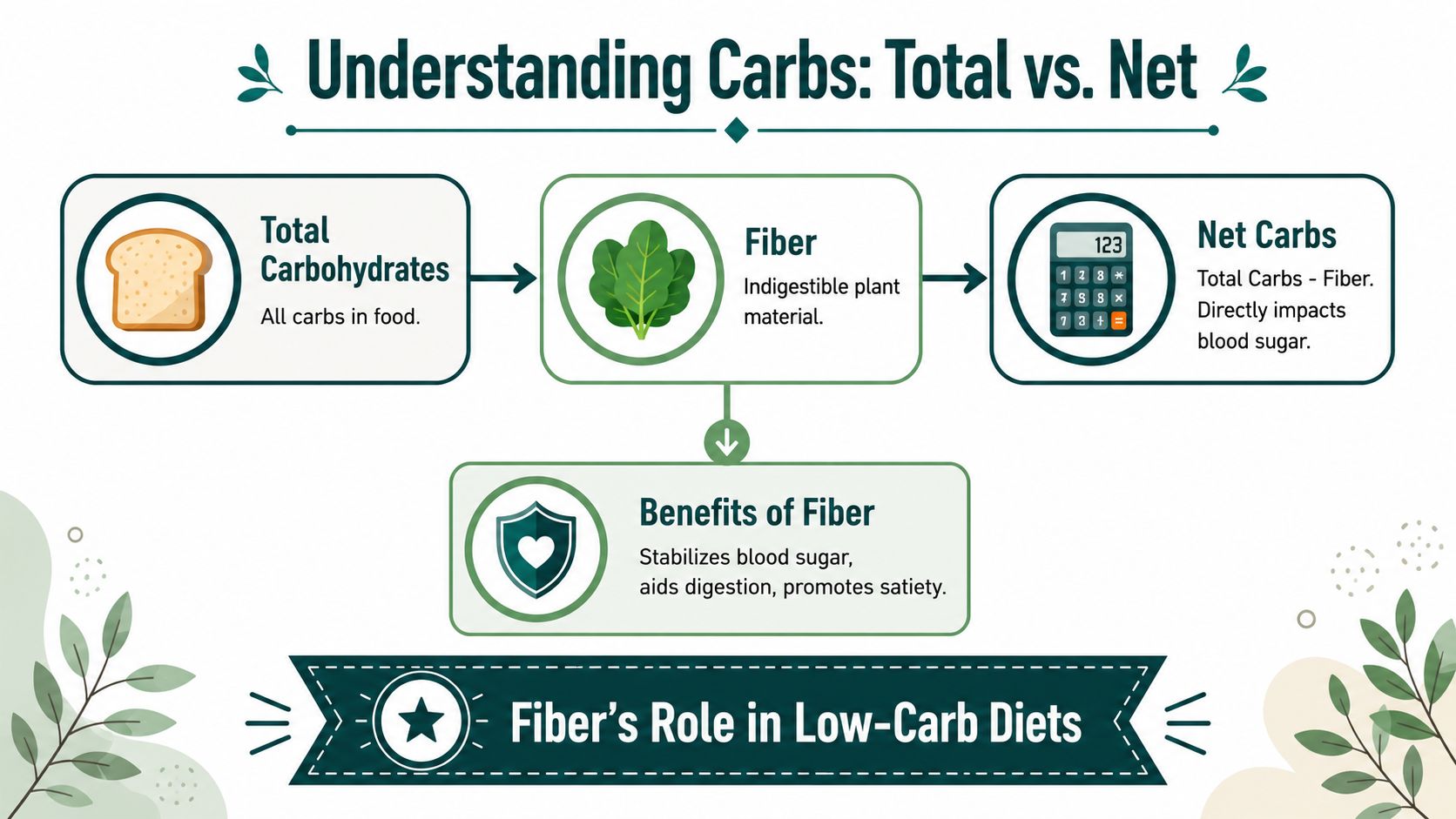
That's why some foods look “high carb” at first glance but fit beautifully into a high fiber low carb pattern. According to GoodRx's food examples for high-fiber low-carb eating, 2 tablespoons of ground flaxseed provide about 5 g total carbohydrate and 4 g fiber, 2 tablespoons of chia seeds provide about 11 g fiber with only 2 g net carbs, and half an avocado provides roughly 7 g fiber with about 9 g total carbohydrate.
Those numbers matter because they change how you shop and build meals. Instead of reacting to total carbs alone, you start asking a better question. How much of this food's carbohydrate is fiber?
A simple way to read labels and meals
Use a simple hierarchy when you assess a food:
Start with total carbs
Check fiber
Estimate net carbs
Decide whether the food brings enough fiber, volume, or nutrients to earn its place
That framework is more useful than “carbs bad, fat good.” It lets you keep foods that improve the overall quality of your diet.
Here's what tends to work:
Seed add-ons: Chia and ground flax can raise fiber without pushing digestible carbs very high.
Fiber-heavy fats: Avocado does more than add fat. It helps meals feel complete.
Low-starch produce: Leafy greens and non-starchy vegetables create volume that low-carb diets often lack.
What usually doesn't work is leaning too hard on engineered substitutes. Many packaged low-carb products market a low net-carb number but don't teach you how to build a durable meal pattern. Whole foods are easier to trust, easier to repeat, and easier to adjust.
If you're curious how your body handles a meal pattern that changes carbohydrate exposure, a structured test like a two-hour oral glucose tolerance test can provide a clearer picture than guesswork alone.
Net carbs are a tool, not a loophole. If the food improves fiber intake and meal quality, it helps. If it just helps a package make a marketing claim, be skeptical.
Metabolic Benefits of a High-Fiber Approach
What the clinical data supports
The strongest case for a high fiber low carb strategy is that it moves the goal away from short-term scale manipulation and toward measurable metabolic improvement.
A 2024 meta-analysis found that in people with diabetes, higher-fiber, higher-carbohydrate diets improved several cardiometabolic markers compared with lower-carbohydrate, lower-fiber diets. The pooled effects included a 0.50% absolute reduction in HbA1c, a 0.99 μIU/mL reduction in fasting insulin, a 0.16 mmol/L reduction in total cholesterol, and a 0.16 mmol/L reduction in LDL cholesterol (2024 systematic review and meta-analysis).
That finding cuts against the simplistic version of low-carb dogma. Lowering carbohydrates isn't automatically superior if the lower-carb version is also lower in fiber. Fiber changes the equation.
Why fiber changes the metabolic picture
Fiber works through several mechanisms that matter for anyone focused on metabolic health rather than diet identity.
First, it slows digestion. That changes the pace of nutrient absorption and often produces a steadier post-meal response than a low-fiber meal built around refined carbs or ultra-processed substitutes.
Second, fiber improves meal structure. High-fiber foods usually bring more chewing, more volume, and more staying power. That makes it easier to avoid the “technically compliant, still hungry” experience that derails many low-carb plans.
Third, fiber supports a healthier gut environment. You don't need to turn this into microbiome mysticism to appreciate the point. A diet with more real plant matter generally behaves differently than one built mostly from animal foods and processed bars.
A practical way to think about this is to separate two goals that people often blend together:
Goal | Lower-carb alone | Lower-carb plus high fiber |
|---|---|---|
Reduce digestible carbs | Often yes | Yes |
Support regularity and food volume | Often inconsistent | More likely |
Improve meal sustainability | Variable | Usually easier |
Align with metabolic markers that matter | Depends on food quality | More likely when whole foods lead |
If you care about fasting glucose, HbA1c, lipids, or inflammation-related trends, food quality matters as much as carb quantity. That's why a broader metabolic framework tends to outperform rigid macro ideology. This article on metabolic health basics and biomarkers is useful if you want the marker side of the picture.
A low-carb diet becomes much more effective when fiber is treated as a target, not an afterthought.
Your High-Fiber Low-Carb Food Guide
A strong high fiber low carb diet isn't built from miracle foods. It's built from repeatable food categories that cover fiber, satiety, and meal flexibility without dragging digestible carbs too high.
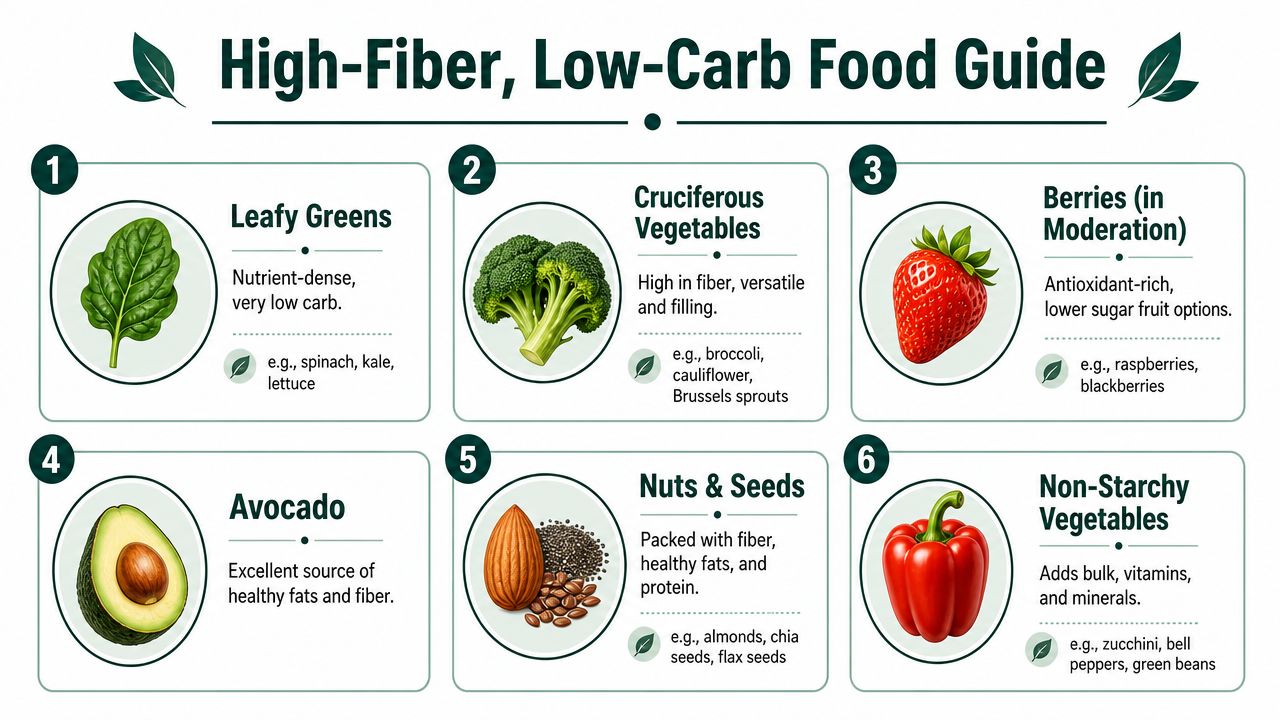
Build meals from these food groups
Think in layers, not isolated ingredients.
Leafy greens. Spinach, kale, romaine, arugula, mixed greens. These create volume fast and work in salads, skillets, soups, and omelets.
Cruciferous vegetables. Broccoli, cauliflower, Brussels sprouts, cabbage. These are your best “bulk” vegetables when you want a meal to feel substantial.
Non-starchy vegetables. Zucchini, bell peppers, mushrooms, cucumber, green beans. Useful for stir-fries, sheet pans, bowls, and snack plates.
Seeds. Chia and ground flax are unusually effective because they can increase fiber in yogurt bowls, smoothies, salads, and puddings without changing the whole meal.
Avocado. One of the easiest ways to make low-carb eating feel more complete rather than restrictive.
Berries in moderation. Helpful when you want a fruit option that still fits the plan, especially paired with protein or unsweetened yogurt.
Nuts. Useful, but easy to overdo. They work best as part of a meal or pre-portioned snack, not as a mindless “healthy” graze.
A practical shortcut is to make every meal answer three questions:
Where is the fiber anchor?
Where is the protein base?
Where is the volume coming from?
If you can't answer all three, the meal usually ends up underpowered.
Here's a visual guide to the core food groups and how they fit together.
High-Fiber Low-Carb Food Cheat Sheet per serving
Use this table as a starting point for foods with verified values available from the cited examples.
Food | Serving Size | Total Carbs (g) | Fiber (g) | Net Carbs (g) |
|---|---|---|---|---|
Ground flaxseed | 2 tablespoons | 5 | 4 | 1 |
Chia seeds | 2 tablespoons | 13 | 11 | 2 |
Avocado | Half a fruit | 9 | 7 | 2 |
That cheat sheet isn't a full grocery database. It's a pattern. Foods that deliver a large share of their carbs as fiber are the backbone of this style of eating.
If you're experimenting with a more plant-forward version of low-carb eating, this overview of plant-based nutrition testing can help you think through what to monitor alongside diet changes.
Sample 3-Day Meal Plan and Recipes
The biggest objection people have to high fiber low carb eating is practical. They can imagine a few approved foods, but not full days that feel normal. That's where most plans fall apart.
The answer is to stop treating fiber as a side quest. Build each day around one seed-based addition, one avocado or cruciferous anchor, and at least two high-volume vegetable exposures. The meals below are templates, not prescriptions.
Day one simple and savory
Breakfast: Greek yogurt or unsweetened yogurt alternative mixed with chia, ground flax, and a small serving of berries.
Lunch: Large salad with leafy greens, grilled protein, avocado, cucumber, and olive oil.
Dinner: Roasted salmon or tofu with cauliflower and sautéed greens.
Snack: A small handful of nuts.
This kind of day works because breakfast does real fiber work instead of pretending coffee and eggs are enough. Lunch adds volume and avocado. Dinner keeps carbs controlled without feeling sparse.
Quick recipe idea: chia bowl
Base: Chia seeds mixed with unsweetened milk of choice
Texture: Add ground flax
Finish: Top with berries and cinnamon
Why it works: It front-loads fiber early, which makes the rest of the day easier
Most people miss fiber in the first half of the day, then try to fix it at dinner. That almost never works well.
Day two more volume less friction
Breakfast: Eggs with sautéed spinach and avocado on the side.
Lunch: Chicken or tempeh bowl with shredded cabbage, roasted broccoli, pumpkin seeds, and tahini dressing.
Dinner: Zucchini noodles or a vegetable-heavy stir-fry with protein and mushrooms.
Snack: Celery or cucumber with a seed-based dip.
This day is lower in obvious carbs but still fiber-conscious because the vegetables are not decorative. They are the meal structure.
Quick recipe idea: loaded avocado salad
Halve an avocado
Fill it with chopped cucumber, herbs, seeds, and protein
Add lemon or vinegar, olive oil, salt, and pepper
Serve over greens or shredded cabbage
That's a useful “I need lunch in ten minutes” meal because it covers fiber, fat, crunch, and satiety without requiring a specialty product.
Day three repeatable enough for busy weeks
Breakfast: Smoothie with unsweetened base, spinach, chia, ground flax, and protein.
Lunch: Leftover roasted vegetables with greens, olive oil, and a protein source.
Dinner: Burger bowl or taco bowl over lettuce and cauliflower rice, topped with avocado and non-starchy vegetables.
Snack: Berries with plain yogurt, or nuts if you need something portable.
Quick recipe idea: roasted vegetable tray
Roast a batch of broccoli, cauliflower, zucchini, and peppers in olive oil with salt and spices. Use it across multiple meals. This is one of the easiest ways to make a high fiber low carb approach sustainable because it removes weekday friction.
What usually doesn't work is trying to hit fiber goals through powders, bars, and heroic willpower. What works is repetition with enough variety to keep the food enjoyable.
How to Track and Optimize Your Progress
A high fiber low carb diet only works if it's working in your body, not just in your tracking app.
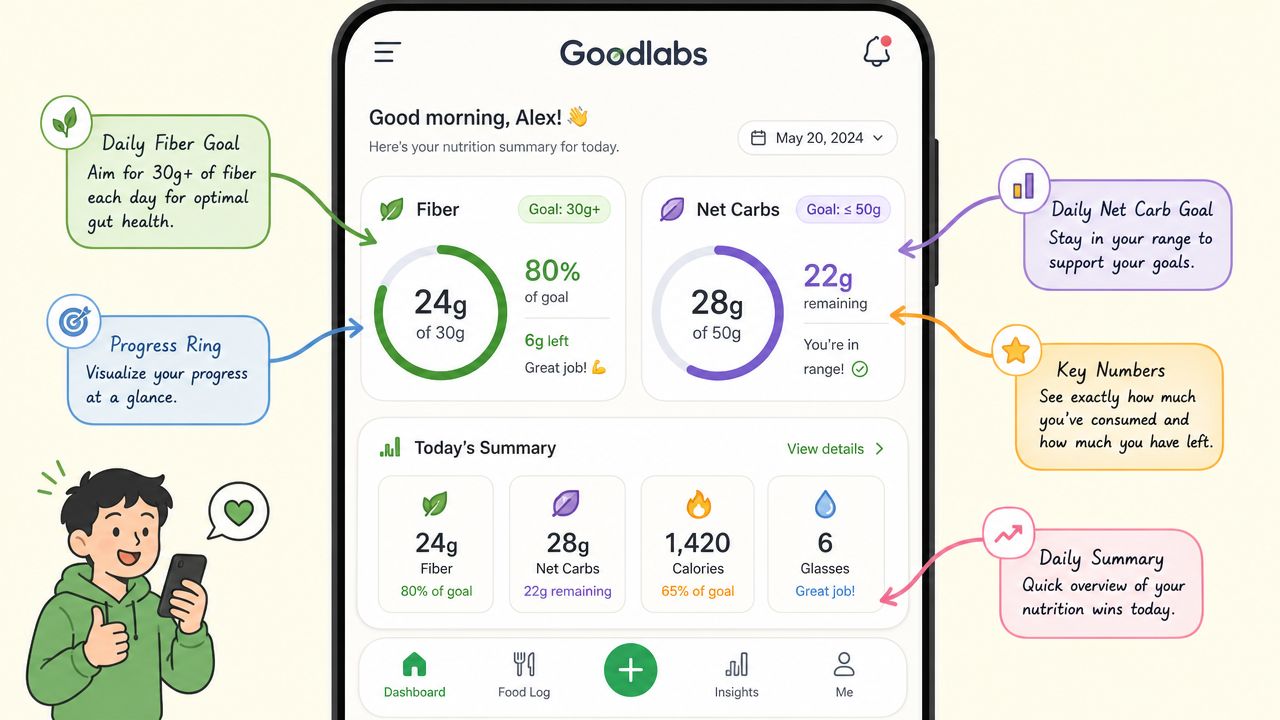
Goodlabs is a health platform that gives blood donors free clinical-grade lab panels (run at Quest or LabCorp), and offers the same panels at low cost to anyone who doesn't want to donate. That matters here because nutrition plans are easy to romanticize and much harder to verify.
Track intake before you assume it is working
One of the most useful observations in this space is also the least glamorous. A key question isn't which foods qualify. It's whether a low-carb approach can still meet evidence-based fiber targets without leaning on processed keto products. Some low-carb plans look fiber-rich on paper but still fall short unless portions are planned carefully, which is why tracking both intake and biomarkers matters (Everlywell discussion of the real-world fiber gap in low-carb diets).
In practice, that means tracking at least three things for a while:
Fiber intake: You need to know whether your meals are adding up.
Net carb intake: Not to chase the lowest number possible, but to understand your baseline.
Food sources: Whole-food fiber behaves differently in a routine than “fortified” snack food fiber.
Do this long enough to notice patterns. Which breakfasts help you hit fiber early? Which lunches leave you hungry two hours later? Which “healthy” snacks are just easy ways to eat less real food?
Use biomarkers to see your response
Food logging tells you what you ate. Biomarkers tell you how your system is responding.
For this style of eating, the most practical markers to watch are the ones connected to glycemic control, inflammation, and lipids. That usually means looking at glucose, HbA1c, hs-CRP (a blood marker associated with systemic inflammation), and a lipid panel. If you're more advanced, ApoB is worth understanding because it reflects the number of atherogenic lipoprotein particles, which can provide a clearer view of cardiovascular risk than LDL cholesterol alone.
The point isn't to obsess over every lab value. It's to avoid running a nutrition experiment blindly for months. A high fiber low carb pattern is supposed to be sustainable, metabolically sane, and measurable. If your digestion improves, your meals are easier to repeat, and your markers move in a better direction, you've built something useful.
For a broader overview of why repeat testing matters, this article on the benefits of regular blood testing is a good companion read.
The solution is simple. When you stop treating low-carb eating like an elimination contest and start treating fiber as a core metabolic lever, the diet becomes easier to live with and more worth measuring. That's when it shifts from a short-term food rule set to a durable health strategy.
If you want to measure how a high fiber low carb approach is affecting glucose control, inflammation, or lipid markers, Goodlabs provides access to clinical-grade testing through CLIA-certified partner labs and also offers free lab panels with eligible blood donation through partner blood centers.
Blood test results are informational and not a medical diagnosis. Talk to your physician about what your results mean for you.
Jake Kaiser
jakesjourney.co