
General Wellness and Longevity
Manage Stress: Top Lower Cortisol Supplements for 2026

Most advice about lower cortisol supplements starts in the wrong place. It assumes your problem is cortisol, assumes it's too high, and assumes a capsule is the right lever.
That's backward.
Feeling wired at night, tired in the morning, anxious, inflamed, or burnt out doesn't automatically mean cortisol is high in a meaningful way. It may reflect poor sleep timing, under-fueling, overtraining, stimulant load, mood strain, illness, or a stress pattern that has more to do with rhythm than raw output. If you skip that distinction, you end up treating a guess.
The better question is simpler and more useful: Is my cortisol dysregulated, and if so, what kind of pattern am I dealing with? That's the difference between buying a trending adaptogen and making a decision that fits your physiology.
Table of Contents
The Right Answer to the Wrong Question
People usually search for lower cortisol supplements when they're already overwhelmed. That's understandable. But symptom chasing creates a false sense of precision. You feel stressed, so you assume cortisol is high. You assume cortisol is high, so you buy a supplement marketed for “adrenal support.” None of that confirms what's happening.
Symptoms aren't a diagnosis
Stress symptoms overlap with a long list of other issues. Poor sleep can mimic “high cortisol.” So can eating too little, drinking too much caffeine, training too hard, or dealing with persistent mental load. Some people also have the opposite problem. They're exhausted and flattened out, yet they still reach for cortisol-lowering products because “stress” seems like the obvious explanation.
Practical rule: If you haven't measured the biomarker, you're not managing cortisol. You're managing a story about cortisol.
That's why the best starting move is often objective testing, followed by context. A lab value doesn't replace symptoms, but it keeps you from building an intervention plan on assumptions. If you want a broader argument for why repeated measurement changes behavior better than guesswork, the case for regular blood testing benefits is strong.
What a smarter starting point looks like
Goodlabs is a health platform that gives blood donors free clinical-grade lab panels (run at Quest or LabCorp), and offers the same panels at low cost to anyone who doesn't want to donate.
That model matters because it lowers the barrier to checking what's happening before you start stacking supplements. For cortisol, the practical sequence is straightforward:
Confirm the problem. Don't assume you need to lower anything.
Match the intervention to the pattern. A night-wired sleep problem is different from post-exercise stress overload.
Treat supplements as secondary tools. They may help, but they don't replace sleep, recovery, nutrition, or medical evaluation.
Individuals don't need a longer list of pills. They need a better question, a cleaner test, and a more honest read on what their body is responding to.
What Is Cortisol Really Doing in Your Body
Cortisol gets framed like a toxin. It isn't. Cortisol is a necessary stress hormone that helps you wake up, mobilize energy, respond to demands, regulate aspects of immune signaling, and adapt to a changing environment.
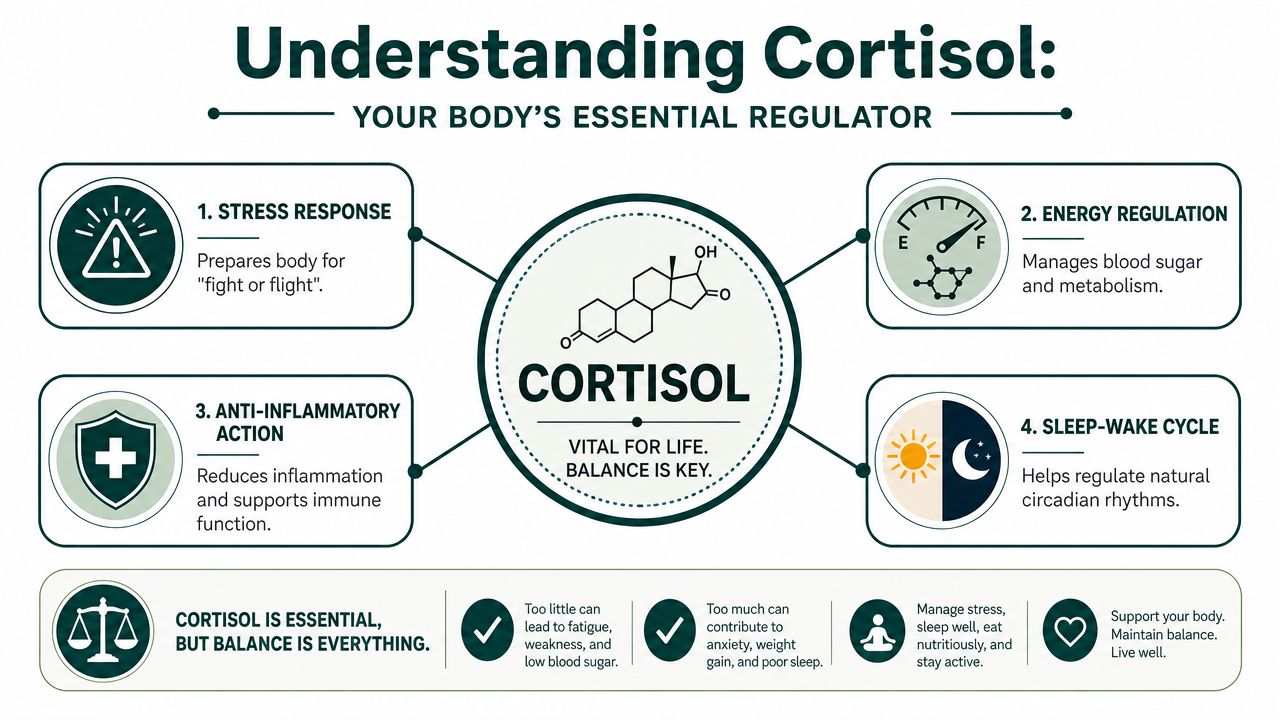
Cortisol is not the enemy
Problems show up when cortisol is high at the wrong time, stays high too long, or reflects a stress system that never really powers down. That's different from saying cortisol itself is bad. If you flatten it indiscriminately, you can make energy, training recovery, and sleep-wake signaling worse instead of better.
A lot of supplement marketing fails the reader. It treats cortisol like a volume knob that should always be turned down. In real physiology, it behaves more like a rhythm. You want the right signal at the right time.
Think command center and factory
A simple way to picture this is to split the system into two parts:
The command center. Your brain coordinates stress signaling through the hypothalamic-pituitary-adrenal (HPA) axis.
The factory. Your adrenal glands respond to those signals and help produce cortisol.
Many people imagine supplements “shutting down” adrenal output directly. That's not how the better-supported adaptogens appear to work. The mechanism for many adaptogens is not direct adrenal suppression. Instead, the evidence points to HPA axis modulation, meaning the supplement may reduce the upstream stress-response signal rather than block cortisol production itself, as explained in this review of what works and what doesn't with cortisol blockers.
Cortisol regulation is less about crushing a hormone and more about restoring a pattern.
That pattern includes daily timing. Cortisol should generally align with your wake-sleep cycle. If your schedule, training, food intake, or stress load keeps sending “threat” signals into the command center, the downstream hormone pattern can drift. That's why random supplement use often disappoints. It addresses the output while ignoring the inputs.
An Evidence Check on Popular Cortisol Supplements
If you're looking at lower cortisol supplements strictly through an evidence lens, one ingredient stands apart. The rest require more nuance.
Ashwagandha has the strongest human data
Ashwagandha is the best-supported supplement for lowering cortisol in the current clinical literature. A systematic review of nine clinical trials found cortisol reductions of roughly 11% to 33% over 30 to 112 days, with 300 to 600 mg/day of standardized extract being the most common dose range, according to this summary of supplements to reduce cortisol.
That matters for two reasons. First, this isn't a one-study wonder. Second, the timeline is practical. The strongest evidence suggests effects appear after 1 to 3 months of daily use, not after a few days.
A more recent controlled study also reported a statistically meaningful cortisol reduction after 8 weeks, with μ = −2.3626, 95% CI of −3.2622 to −1.4629, and p < 0.0001. The same study found improvement in perceived stress, with μ = −4.88, 95% CI: −7.84 to −1.91, and p = 0.0013, as reported in this clinical paper on ashwagandha and stress outcomes.
The practical read is clear. If someone has sustained psychological stress and wants the supplement with the most repeatable human data, ashwagandha is the reference point.
Other supplements are more context dependent
Once you move beyond ashwagandha, confidence drops and context starts to matter more.
Phosphatidylserine is the best example. It may be more relevant when the problem is cortisol spikes after physical exertion or sustained mental work, not generalized everyday stress. That makes it a better fit for certain athletes, shift workers, or people whose recovery feels blunted after hard effort.
L-theanine and rhodiola are common on “top supplement” lists, but the consumer guidance around them is often broader than the evidence deserves. They may help some people feel calmer or more resilient, yet the direct cortisol evidence is less established and more heterogeneous. That doesn't mean they never help. It means they're harder to match with confidence if your goal is measurable cortisol change.
If you're trying to understand stress biology more broadly, it can also help to look at related hormones such as DHEA-S and what it can tell you about adrenal signaling.
If your goal is “pick one supplement most likely to move cortisol on paper,” choose the ingredient with repeated human data. If your goal is “pick the right tool for my stress pattern,” context matters more than popularity.
Evidence Summary for Cortisol-Modulating Supplements
Supplement | Evidence Strength | Common Dose Range | Primary Use Case |
|---|---|---|---|
Ashwagandha | Strongest among popular options | 300 to 600 mg/day standardized extract | Chronic stress patterns where measurable cortisol reduction is the goal |
Phosphatidylserine | Context dependent | Not clearly established here for general use | Exercise-related or workload-related cortisol spikes |
L-theanine | Limited direct cortisol evidence | Not established here | Situational calming, especially when mental overstimulation is prominent |
Rhodiola rosea | Limited and mixed for direct cortisol lowering | Not established here | Stress resilience support, with less certainty for measurable cortisol reduction |
Safety Side Effects and Who Should Be Cautious
The bigger mistake is assuming cortisol needs to come down at all. In practice, I see people use “lower cortisol” products to treat symptoms that were never linked to high cortisol in the first place. If you have not tested, you are still guessing. Guessing is where side effects and wasted effort tend to pile up.
Safety depends on the person, the product, and the reason for use
Ashwagandha is the best example of why nuance matters. Short-term studies often report it as well tolerated, but that does not answer the question that matters for real-world use: what happens with longer use, higher doses, variable product quality, and concurrent medications? The NIH Office of Dietary Supplements fact sheet on ashwagandha notes that adverse effects can occur and that special caution is warranted in specific groups, including people who are pregnant and those with certain medical conditions.
That gap between short-term tolerance and long-term certainty matters. A supplement can look fine in a study and still be the wrong choice for someone with thyroid disease, autoimmune issues, GI sensitivity, or a complicated medication list.
Who should pause and assess first
Use more caution if any of these apply:
You take prescription medications. Sedatives, thyroid medication, blood sugar medication, blood pressure medication, and immunosuppressive drugs deserve a medication review before adding stress-related supplements.
You have endocrine or thyroid symptoms. Fatigue, palpitations, menstrual changes, temperature intolerance, unexplained weight change, or hair loss should push you toward testing before self-treatment.
You are pregnant, trying to conceive, or breastfeeding. Safety data are not strong enough to treat these supplements casually.
You have autoimmune disease or a history of hormone-sensitive conditions. “Adaptogenic” is not the same as universally appropriate.
You plan to stay on it for months. Long-term use raises a different safety question than a short trial.
One more group belongs on this list. People with normal cortisol patterns but high stress symptoms often need a broader workup, not a cortisol-lowering supplement. Sleep disruption, under-fueling, overtraining, anxiety, alcohol use, and blood sugar instability can all mimic a “high cortisol” problem.
Side effects are usually predictable if you know what you are looking for
Common issues are not mysterious. They are usually dose-related, product-related, or context-related. Depending on the ingredient, that can mean GI upset, sedation, vivid dreams, headache, dizziness, or feeling flat during the day when the goal was to take the edge off at night.
This is why I prefer a clear trial plan. Define the symptom you want to change, the timeframe, and the stop points. If energy drops, sleep gets worse, digestion changes, or labs move in the wrong direction, the experiment is over.
A useful checkpoint is whether you can explain why you are taking the supplement and what result would count as success. If you cannot answer that clearly, review your labs first. This guide to understanding hormone panel results can help you frame that decision before you add another variable.
Lifestyle Strategies That Actually Regulate Cortisol
Supplements can help at the margins. Lifestyle is what sets the signal.
If your brain keeps receiving cues of threat, overload, sleep loss, under-recovery, or unstable fueling, no adaptogen is going to override that input. Cortisol follows demand. Lower the demand or improve your capacity to handle it, and the system usually becomes easier to regulate.
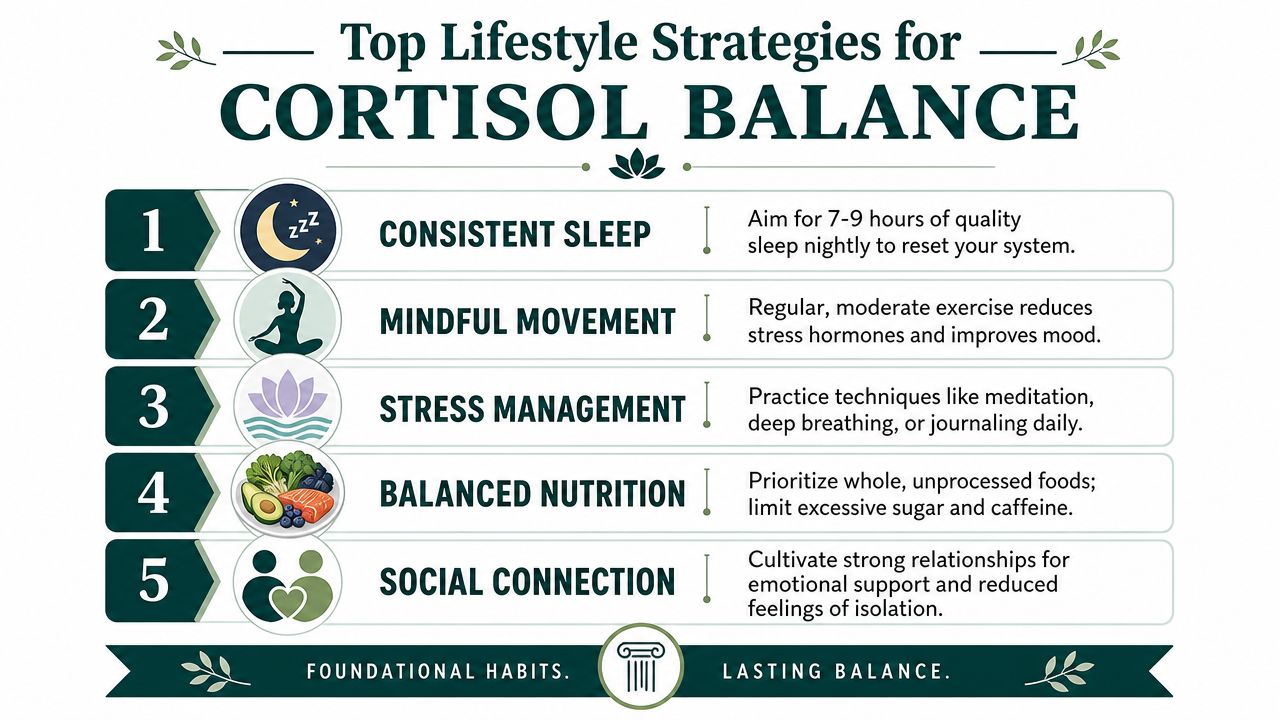
Fix the signal before you blunt the symptom
The most effective first-line strategies aren't glamorous:
Sleep regularity
Reasonable training load
Stable meals with enough total intake
Less late-day stimulation
Some form of nervous system downshifting
That's the unsexy truth. A supplement may smooth the edges. It won't rescue a body that's being asked to stay on alert around the clock.
Five levers that matter most
Sleep timing comes first. If you're sleeping at inconsistent times, waking often, or pushing through chronic sleep debt, your cortisol rhythm usually reflects that strain. Protect your wake time and your wind-down routine before you buy another bottle.
Exercise should build resilience, not drain it. Training is a stressor. Used well, it improves stress tolerance. Used poorly, especially with under-fueling or inadequate recovery, it can push the stress system in the wrong direction.
Most “high cortisol” complaints I see in active people are really a recovery problem.
Nutrition needs to be boringly competent. Skipping meals, chasing stimulants, and living on convenience food creates a physiologic stress signal. Balanced intake won't feel as dramatic as a supplement, but it often does more.
Stress management has to be concrete. Breathing drills, walking, journaling, meditation, and reducing friction in your schedule all count. The point isn't to become serene. The point is to give your brain repeated evidence that it can power down.
Social connection matters. Isolation keeps people in a more vigilant state than they realize. Consistent support changes how stress is processed.
For people working on sleep, energy, and glucose stability together, the broader topic of metabolic health often ends up being part of the same picture.
How to Test Your Cortisol and Make It Count
Testing is where this topic gets practical. Most content about lower cortisol supplements skips the part that matters most. How do you verify that cortisol is the problem, and how do you measure it in a way that means something?
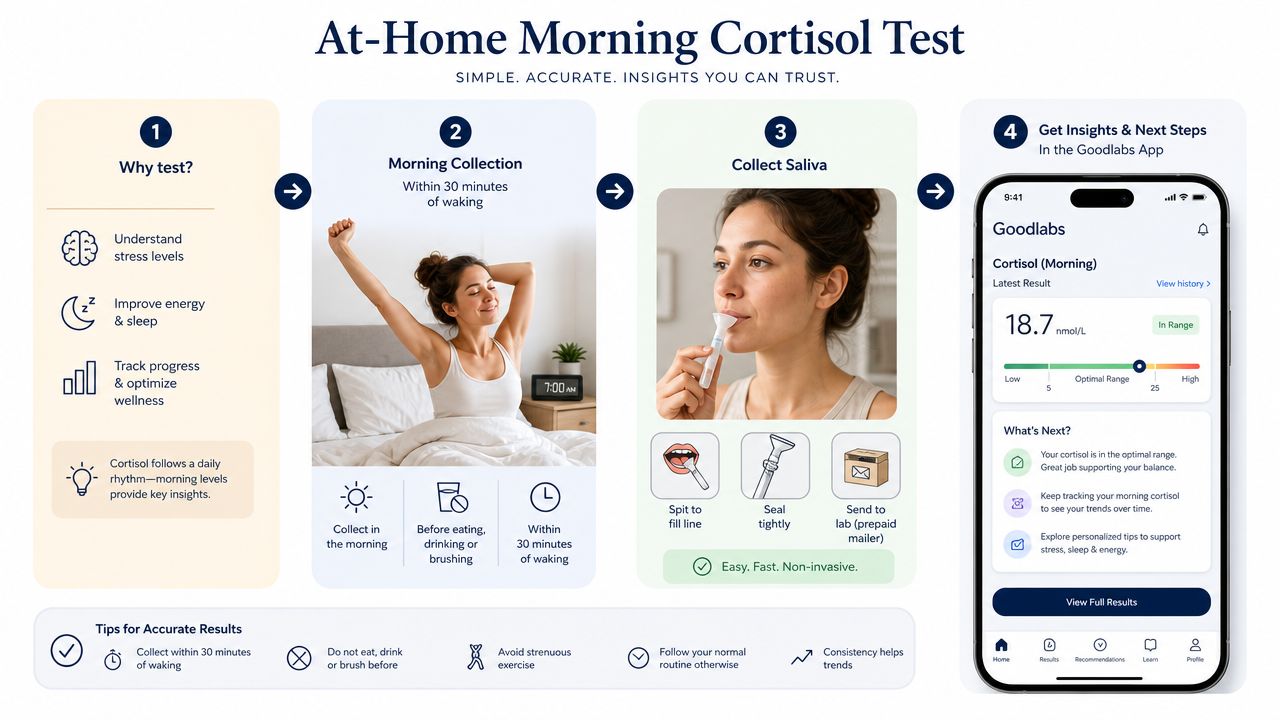
Why timing matters
Cortisol is a timing-sensitive biomarker. A result only makes sense if you know when it was collected and what your recent sleep, training, illness, and stress context looked like. Random, untimed testing is much harder to interpret because it strips away the rhythm.
This is the major gap in consumer guidance. A systematic review highlighted the lack of clarity around when and how to verify high cortisol, and it underscored the need for objective biomarker tracking rather than assuming supplements are the first step, as discussed in this systematic review on testing and supervision considerations.
If you want a direct lab option, a cortisol total LCMS test is the kind of measurement that can anchor a more informed next step.
How to use one result well
A single result is a snapshot, not a verdict. That means you should interpret it alongside questions like:
What time was the sample taken?
How did you sleep the night before?
Did you train hard recently?
Have you been under unusual psychological stress?
Are symptoms happening at a specific time of day?
Those details often explain more than the number alone.
A short walkthrough can help if you're new to cortisol testing:
The true value of testing isn't collecting a score. It's building a baseline you can compare against your symptoms, your routines, and any interventions you try later. Without that, supplement decisions stay speculative.
From Data to Action Your Cortisol Roadmap
A cortisol result shouldn't push you straight into self-treatment. It should sharpen your next question.
Step one is interpretation not self-treatment
Start with the boring but important move. Review the result with a physician, especially if symptoms are significant, unusual, or persistent. Cortisol patterns can reflect more than stress. They can also be shaped by medications, illness, sleep disruption, and broader endocrine issues.
That's why the right response isn't “my cortisol is off, so I need a blocker.” It's “what does this result mean in context, and what root cause still needs attention?”
The test is not the endpoint. It's the filter that keeps you from taking the wrong action confidently.
Build a targeted plan and reassess
Once you've ruled out the obvious medical concerns, build your plan in layers:
Fix the high-yield inputs first. Sleep timing, recovery, food intake, and stimulant load.
Choose a supplement only if it matches the pattern. Chronic stress may justify ashwagandha more than a workout-related spike would.
Track symptoms with specifics. Energy on waking, evening alertness, training recovery, sleep onset, and irritability are more useful than “I feel stressed.”
Re-test after a reasonable interval. The point is to see whether your actions changed the pattern, not whether you felt temporarily reassured by taking something.
This approach changes the whole experience. You stop shopping for promises and start running a feedback loop. That's the breakthrough. Better decisions, fewer unnecessary supplements, and a much clearer sense of what moves your stress physiology.
FAQs Lower Cortisol Supplements 2026
Are lower cortisol supplements worth trying
Sometimes, yes. They're most useful when the stress pattern is clear, the product fits the use case, and you're also addressing sleep, recovery, and nutrition. They're weak substitutes for basic physiology.
Which supplement has the best evidence for lowering cortisol
Ashwagandha has the strongest support. It has the best human evidence for measurable cortisol reduction, especially in chronically stressed adults, and it works over weeks rather than immediately.
How long do cortisol supplements take to work
Usually weeks, not days. The strongest data for ashwagandha points to daily use over a meaningful stretch of time, which is why it shouldn't be treated like a rapid calming aid.
Should you test cortisol before taking supplements
Yes, if you want to be precise. Testing helps confirm whether cortisol is part of the problem and gives you a baseline for deciding whether lifestyle changes or supplements are doing anything measurable.
Can lowering cortisol make you feel worse
Yes, it can. Cortisol is necessary for energy, rhythm, and adaptation. If the issue is poor timing, under-recovery, or a different root cause, trying to force it down may backfire.
Goodlabs can help you move from stress guessing to biomarker-driven decisions. If you want affordable clinical-grade testing through CLIA-certified partner labs, or free lab panels with a qualifying blood donation, explore Goodlabs.
Blood test results are informational and not a medical diagnosis. Talk to your physician about what your results mean for you.